


center of gravity
 11-22-2006 | 02:54 PM
#1
Thread Starter
Member
Joined: Oct 2006
Posts: 53
Likes: 0
Received 0 Likes
on
0 Posts
From: east mckeesport, PA
 center of gravity
I see that knowing the center of gravity of your plane is important.My questions are ,How do you find it on a plane you did not build?Do you need one of those tools I've seen?Have read that you measure back from leading edge of wing and pick up at this point to see if plane balances.How do you do this with a plane with a 6 foot wingspan?With help?
 11-22-2006 | 03:45 PM
#2

Senior Member
My Feedback: (6)
Joined: Mar 2002
Posts: 1,237
Likes: 0
Received 0 Likes
on
0 Posts
From: New London,
OH
RE: center of gravity
rule of thumb is 25% of the wing cord is the balance point. If the wing is 12" wide then the balance point would be 3" back from the leading edge. This is for a constant cord wing, like a trainer. Flat bottom trainers almost always balance at the wing spar. On a tapered wing, if you use the wing spar you should be close enough to test fly it. If it is a foam wing, you can use the thickest part of the airfoil.
11-22-2006 | 04:32 PM
#3
Senior Member
Joined: Apr 2003
Posts: 497
Likes: 0
Received 0 Likes
on
0 Posts
From: beaverton, OR,
RE: center of gravity
As mentioned in the previous post. If it is a high wing plane measure back from the leading edge of the wing (on the bottom) about 25% of the chord ( the distance from leading edge to trailing edge) and put a mark close to the side of the fuselage (on each wing). You can then pick plane up using your finger tips on those marks and the plane should sit level or a bit nose down. If it is a low wing plane, do the same except put the marks on the top of each wing and turn the plane upside down to balance. Pretty basic but it gets you pretty close....
11-22-2006 | 05:19 PM
#4
Thread Starter
Member
Joined: Oct 2006
Posts: 53
Likes: 0
Received 0 Likes
on
0 Posts
From: east mckeesport, PA
RE: center of gravity
you can then pick plane up using your finger tips on those marks and the plane should sit level or a bit nose down.
Thanks for the info....I thought you picked up plane at wing tips....not close to the fusalage
11-22-2006 | 06:23 PM
#5

Senior Member
Joined: Nov 2004
Posts: 2,448
Likes: 0
Received 0 Likes
on
0 Posts
From: Lincoln,
NE
11-22-2006 | 06:46 PM
#6
Senior Member
Joined: Apr 2003
Posts: 497
Likes: 0
Received 0 Likes
on
0 Posts
From: beaverton, OR,
RE: center of gravity
WOW!!!!! [X(] First time I've seen anything like this. I know some of my flying buddies that are into 3D etc. will find it interesting. Might be a little too deep for a newie ( it is for me), but what the heck he'll never need to know more. 
11-22-2006 | 07:39 PM
#7

Senior Member
My Feedback: (4)
RE: center of gravity
Here is my rule of thumb for finding CG:
IF I were given a plane and had no idea where it should balance, I would balance it on the spar, but make sure it sits slightly nose-down - Because a nose heavy airplane will be sluggish, but it will still fly - A tail-heavy plane will be uncontrollable.
Then fly it.
Once airborne, First thing is to see how it handles. If it handles ok, I'll try a spin. If it won't spin, that's usually a good indication that it is nose-heavy.
Next comes the landing. If it won't slow down, that's another indication that it is nose-heavy
So if I have determined that it is nose-heavy, I will move the CG back in small increments (1/8 - 1/4" at a time depending on how bad it was the first time) until it flies the way I want it to.
IF I were given a plane and had no idea where it should balance, I would balance it on the spar, but make sure it sits slightly nose-down - Because a nose heavy airplane will be sluggish, but it will still fly - A tail-heavy plane will be uncontrollable.
Then fly it.
Once airborne, First thing is to see how it handles. If it handles ok, I'll try a spin. If it won't spin, that's usually a good indication that it is nose-heavy.
Next comes the landing. If it won't slow down, that's another indication that it is nose-heavy
So if I have determined that it is nose-heavy, I will move the CG back in small increments (1/8 - 1/4" at a time depending on how bad it was the first time) until it flies the way I want it to.
11-22-2006 | 08:00 PM
#8
 RE: center of gravity
One thing that I can tell you is CG is VERY important. I've known guys who get an RTF or an ARF and think there is no reason to bother checking it. Believe me, if it is too far back, you'll crash the plane. I know from personal experience. I've also known people to get rid of a poor flying plane that might have been made better by setting the CG correctly. Even if you didn't put the plane together, chances are you know who manufactured the kit or ARF. You can usually download manuals from company web sites. Also, whatever plane you might have, somebody else on here likely has one too and can help with the CG. Here's a good link:http://www.495thsquadron.org/TechTalk-CG.htm For most planes though you can usually just locate the CG on the wing and use your fingertips to lift the plane up. Another often overlooked factor is lateral balance. If one side of the plane is heavier that the other, flight will be affected. A little time spent doing a lateral balance adjustment can make a good plane even better. Hope this helps.
11-23-2006 | 09:34 AM
#9
Thread Starter
Member
Joined: Oct 2006
Posts: 53
Likes: 0
Received 0 Likes
on
0 Posts
From: east mckeesport, PA
RE: center of gravity
OK....I think I've got the idea of how to find CG....Now,previous post have mentioned "setting CG"...How is this done??
Also,My plane is a Hangar 9 Xtra Easy 40....and there is no mention of CG in the manual.
Also,My plane is a Hangar 9 Xtra Easy 40....and there is no mention of CG in the manual.
11-23-2006 | 10:18 AM
#10
Senior Member
Joined: Apr 2003
Posts: 497
Likes: 0
Received 0 Likes
on
0 Posts
From: beaverton, OR,
RE: center of gravity
Mike, Finding and setting the CG are the same thing. Once the CG point is found ( set) then you balance the plane to that point as previous posted. If you look in the manual towards the back there should be a page that mentions the control surface movements and the balance point (CG). If you still have problems you would be best advised to go to a hobby shop or a R/C Club and get some personal help, then you can see and perhaps better understand. Good Luck
11-23-2006 | 11:39 AM
#11
RE: center of gravity
If you find that your CG is not in the correct spot, try moving the battery and/or the reciever around until it balances correctly. Hopeflly this is all you will have to do. If moving those doesn't do it, you may be forced to add a little weight. Hobby shops sell stick-on lead weights just like the ones used for tires. Don't rely on the weight's sticky adhesive though. I usually epoxy the weights inside the plane or secure them to the outside with screws. Most of your beginner type planes that come from reputable manufacturers do a pretty good job of explaining this stuff in their manuals.
11-23-2006 | 12:27 PM
#12

My Feedback: (7)
Joined: Feb 2002
Posts: 2,051
Likes: 0
Received 0 Likes
on
0 Posts
From: Keller, TX
RE: center of gravity
ORIGINAL: pghmike
OK....I think I've got the idea of how to find CG....Now,previous post have mentioned "setting CG"...How is this done??
Also,My plane is a Hangar 9 Xtra Easy 40....and there is no mention of CG in the manual.
OK....I think I've got the idea of how to find CG....Now,previous post have mentioned "setting CG"...How is this done??
Also,My plane is a Hangar 9 Xtra Easy 40....and there is no mention of CG in the manual.
12-14-2006 | 04:27 PM
#13
Member
Joined: Aug 2006
Posts: 70
Likes: 0
Received 0 Likes
on
0 Posts
From: Saint Louis,
MO
RE: center of gravity
At the risk of being redundant, I suggest this:
If the recommended location of the airplane's CG is unknown, use the calculator provided further up in this thread. It looks complex, but MAC is not meaningful if the wing is straight and square. The neutral point they refer to is the center of lift. For models you always want your CG a little ahead of the NP.
I checked a "Hershey Bar" wing shape and it suggests a CG point located roughly 30% of the wing chord (width, NOT SPAN) back from the leading edge. The 30% rule of thumb is a good starting point for any straight square wing. Swept and tapered wings are a little more complex and the MAC (Mean Average Chord) becomes important.
After locating the required CG, test your plane by balancing on your fingertips as described farther up. Move stuff around or add weight until it balances WITH AN EMPTY FUEL TANK. You want to end up good on an empty tank rather than start in balance and get tail-heavy at the end of a flight.
Always re-balance used airplanes you buy, and after repairs or engine changes. Even small repairs to the nose or tail can dramatically change the balance point. Best of luck.
N
If the recommended location of the airplane's CG is unknown, use the calculator provided further up in this thread. It looks complex, but MAC is not meaningful if the wing is straight and square. The neutral point they refer to is the center of lift. For models you always want your CG a little ahead of the NP.
I checked a "Hershey Bar" wing shape and it suggests a CG point located roughly 30% of the wing chord (width, NOT SPAN) back from the leading edge. The 30% rule of thumb is a good starting point for any straight square wing. Swept and tapered wings are a little more complex and the MAC (Mean Average Chord) becomes important.
After locating the required CG, test your plane by balancing on your fingertips as described farther up. Move stuff around or add weight until it balances WITH AN EMPTY FUEL TANK. You want to end up good on an empty tank rather than start in balance and get tail-heavy at the end of a flight.
Always re-balance used airplanes you buy, and after repairs or engine changes. Even small repairs to the nose or tail can dramatically change the balance point. Best of luck.
N
12-15-2006 | 12:18 AM
#14
 RE: center of gravity
The best way I've found to find the balance point quite accurately is to make up a long loop of string that hangs from a hook in the middle of the loop so each end supports the model around the fuselage in front of and behind the wing. The model then hangs like a pendulum so the CG is directly under the hook. Adjust the model in the string cradle so the fuselage and wings are level. Hang another piece of string with something like a pointed fishing sinker from the same hook and it'll point directly at the CG. While it's hanging you can add weights wherever you like to move the CG to where you need it before sticking them on.
12-15-2006 | 03:58 AM
#15
Senior Member
Joined: Dec 2006
Posts: 405
Likes: 0
Received 0 Likes
on
0 Posts
From: Perth Australiaaustralia, AUSTRALIA
RE: center of gravity
try cg at the wing spar then move batt or receiver if that not enough go to a tyre place to get the stick on weights you pay to much at most hobby shops
12-15-2006 | 08:32 AM
#16
Banned
Joined: Jun 2006
Posts: 1,159
Likes: 0
Received 0 Likes
on
0 Posts
From: Lacona,
NY
RE: center of gravity
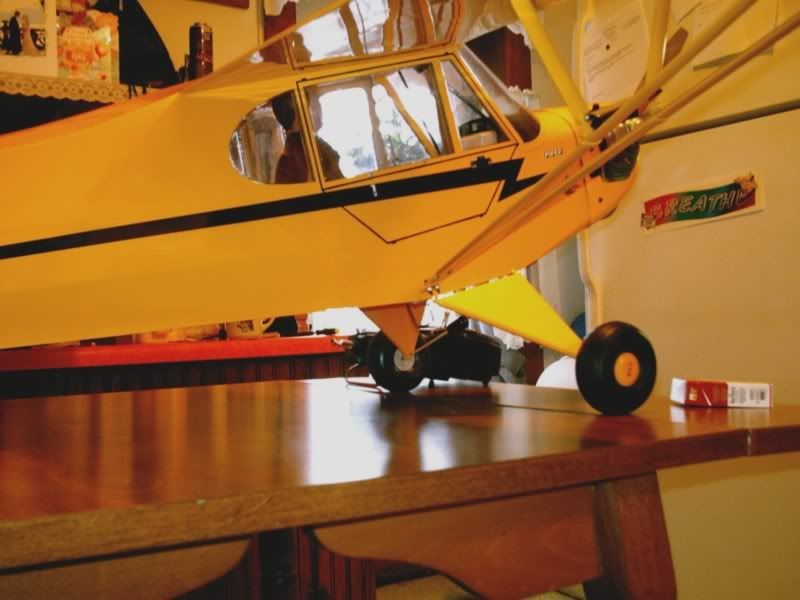
I usually mark the measured ballancing point with a felt tip marker, then I use this device to make sure it ballances on the mark and slightly nose heavy. Works great! And I learned this little trick from some of the guys in here. 

Peter Dowling aka Luftwaffe Oberst
AMA District II # 865404
Aero Modelers Club
Pulaski, NY
Peter Dowling aka Luftwaffe Oberst
AMA District II # 865404
Aero Modelers Club
Pulaski, NY
08-15-2007 | 07:02 AM
#17


Joined: Mar 2006
Posts: 1,442
Likes: 0
Received 0 Likes
on
0 Posts
From: Tehachapi, CA
RE: center of gravity
Ok that looks like an easy device to make for checking CG. Are those dowls your using? they dont puncture the wing covering monocoat when setting the plane on them? A little more information intrested in making my own Cg machine. SHouldnt be difficult.


