


Replace brushless motor with larger motor
 06-27-2022 | 06:40 PM
#1
Thread Starter

My Feedback: (6)
Joined: Feb 2005
Posts: 109
Likes: 0
Received 0 Likes
on
0 Posts
From: Goshen, IN
 Replace brushless motor with larger motor
I have a medium size airplane that has a 400 watt brushless motor on it turning a 11" x 5.5e prop running on a 3 cell 2200 mahr battery. At full throttle, about 8,000 rpm, the motor pulls 17.3 amps at about 200 watts. I would like a little more power and since I had to add 4 oz of nose weight to make the airplane balance, was thinking of replacing the motor with a larger one. Maybe something in the 600 to 800 watt range. The motor is a 1000kv motor. I thought that at the medium voltage of about 11.8 volts, the motor would produce a rpm of about 10,000 rpm allowing for some efficiency losses and that the amperage would increase from my measured 17.3 amps in order to produce more rpm then my 8,000 rpm? If I went to a 800 watt 1000kv motor, would I get about the same rpm since both motors are 1000kv motors? Would the measured amperage and wattage be about the same? Would I get about the same flight time from my battery assuming I was using the same size prop? So, what pros and cons would I have going to a larger heavier motor?
 06-27-2022 | 10:25 PM
#2

Joined: Nov 2010
Posts: 1,710
Likes: 0
Received 81 Likes
on
77 Posts
From: Coffs Harbour NSW, AUSTRALIA
You are better off upgrading the motor, rather than carrying the dead weight in the nose. Might need to upsize the prop, also cell count to 4S, but it's all subject to the motor specs you'll choose, to suit AUW of your model.
06-28-2022 | 07:36 AM
#3
Thread Starter
My Feedback: (6)
Joined: Feb 2005
Posts: 109
Likes: 0
Received 0 Likes
on
0 Posts
From: Goshen, IN
Would like to stay with the 3 cell batteries since I already have some. Just would like to find out what going to a bigger higher wattage motor would do to my flight times assuming I am using the same prop. Since both motors would be 1000kv motors, does the amperage, RPM, and wattage stay about the same? Only difference would be that the bigger motor would not have to work as hard and stay cooler? Would the bigger 800 watt motor only draw about 200 watts like the smaller one since it is spinning the same prop?
06-28-2022 | 05:58 PM
#4
Joined: Nov 2010
Posts: 1,710
Likes: 0
Received 81 Likes
on
77 Posts
From: Coffs Harbour NSW, AUSTRALIA
Larger motor will naturally draw more current, so your flight time will be shorter. Every motor gives you basic specs, with recommendation what's the ideal prop to use for efficiency, check that before buying the one to suit your model.
It makes no sense doubling the wattage and sticking with the same prop.
It makes no sense doubling the wattage and sticking with the same prop.
06-29-2022 | 04:57 PM
#5

Efficiency of a bigger motor is slightly higher because of aforementioned lower resistance and because the motor will operate closer to point of maximum efficiency.
Velocity_konstant_Kv of the new motor should not differ too much though, because both current and power drawn are proportional to Kv cubed, a very disproportional effect. Unless the power system can handle the increase of course.
E.g. a
05-10-15-20-25% difference in Kv would lead to a
15-30-50-70-95% difference in current and power drawn.
More expensive
Vriendelijke groeten
 Ron
Ron• Without a watt-meter you're in the dark ... until something starts to glow •
• E-flight calculators • watt-meters • diy motor tips&tricks • Cumulus MFC •
Last edited by ron_van_sommeren; 06-29-2022 at 05:17 PM.
06-30-2022 | 01:44 AM
#6
Joined: Nov 2010
Posts: 1,710
Likes: 0
Received 81 Likes
on
77 Posts
From: Coffs Harbour NSW, AUSTRALIA
Would like to stay with the 3 cell batteries since I already have some. Just would like to find out what going to a bigger higher wattage motor would do to my flight times assuming I am using the same prop. Since both motors would be 1000kv motors, does the amperage, RPM, and wattage stay about the same? Only difference would be that the bigger motor would not have to work as hard and stay cooler? Would the bigger 800 watt motor only draw about 200 watts like the smaller one since it is spinning the same prop?
One of my recent creation, a larger Bi plane is a great example, initially fitted with "EF110" and model coming heavier than expected, I knew as soon as I hooked it up on thrust scale and E-meter it will be very marginal.
Minor upgrade to "EF160" did all the difference, still the same voltage but larger prop with abundance of power at 1.5 to 1. Easy fix.
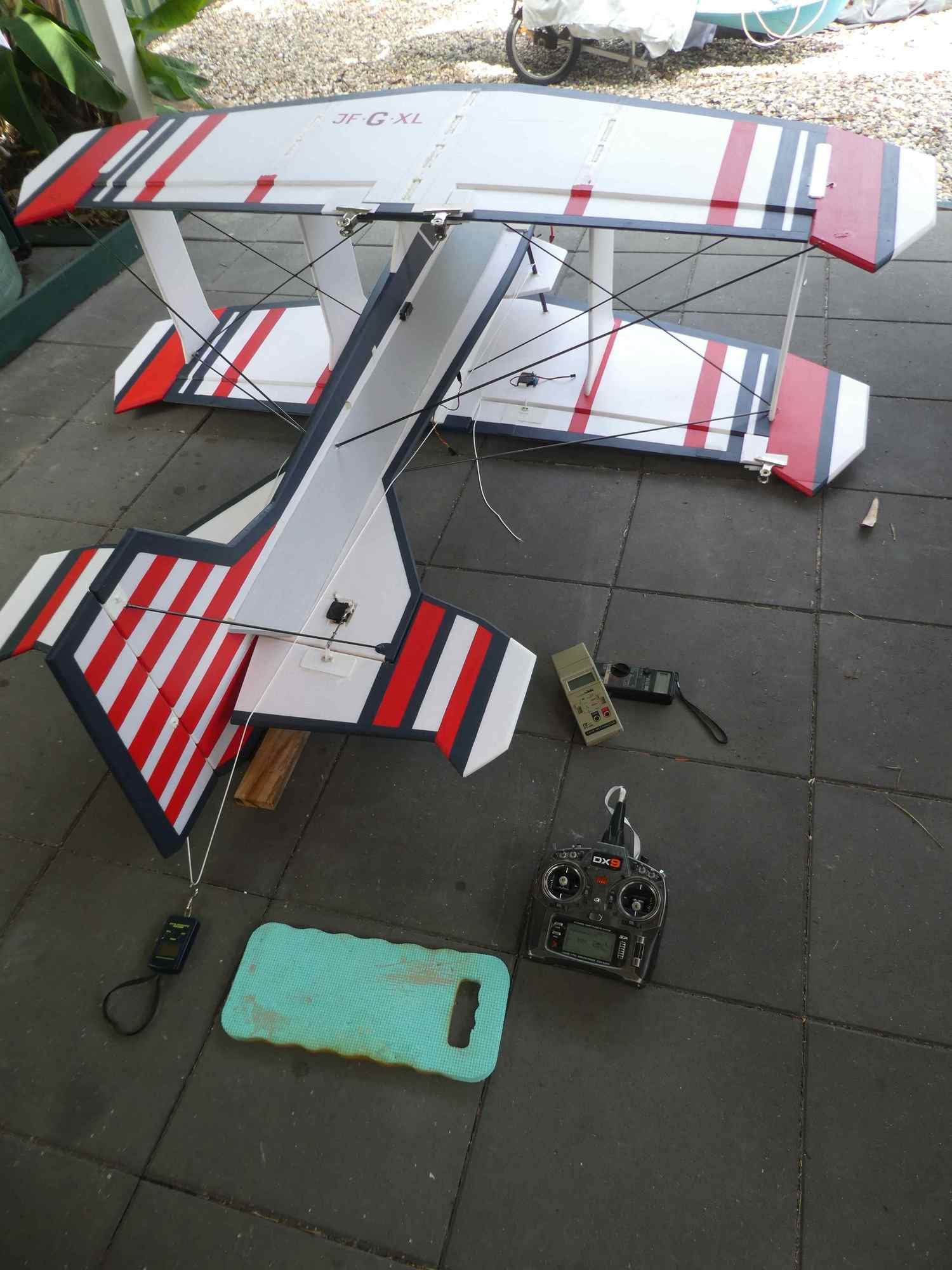
E-meter with pull scale is easiest way to find out how good will it perform.
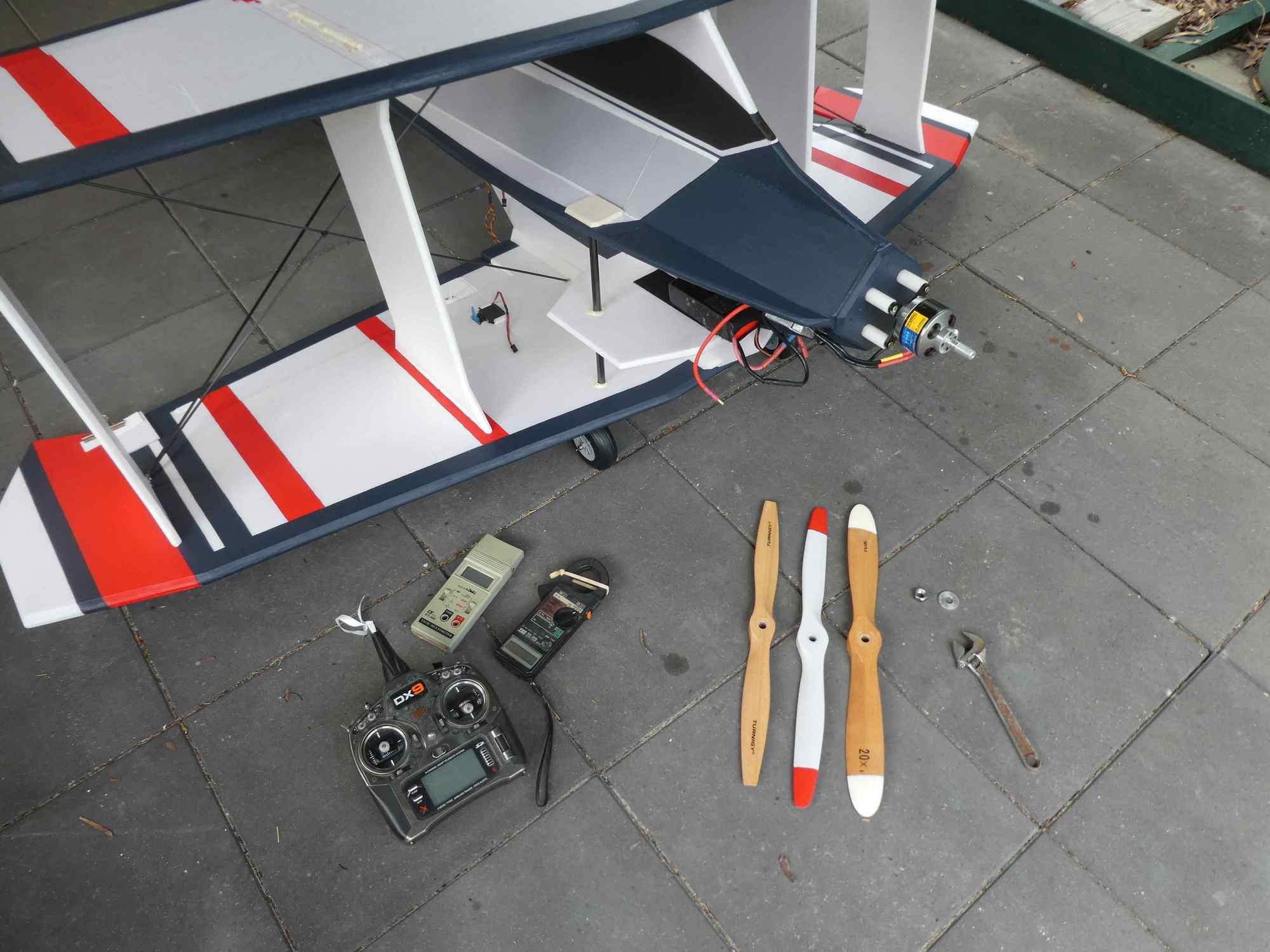
RPM/Current and Thrust checks using various props.

Easiest option was motor upgrade.

Massive improvement after motor upgrade.

In action - where it belong.
07-02-2022 | 04:58 AM
#7
Thread Starter
My Feedback: (6)
Joined: Feb 2005
Posts: 109
Likes: 0
Received 0 Likes
on
0 Posts
From: Goshen, IN
Testing results
I had a friend give me one of his larger motors and ESC so I did some experimenting. I did the test with a 2200 mahr 3 cell battery that was about 50% charged ( 11.6 volts). Prop 11x5.5E APC .
Original Motor Propdrive V2 2836 New larger Motor GForce 3536
1000 kv, 400 watt, max current 30 A 1100 kv, 450 watt ??, max current 43 A
Full throttle test results
RPM 7,800 9,100
Amps 16.6 26.6
Watts 188 288
V full throttle 10.8 10.4
As you can see a LOT more power. This isn't an airplane that I would fly at full throttle all the time, so if I only fly it that way for a very short periods, my flight time might be somewhat similar? What do you think? Does my testing results look valid to you? I am somewhat new to electric motor power so any advice would be welcome. thanks
Original Motor Propdrive V2 2836 New larger Motor GForce 3536
1000 kv, 400 watt, max current 30 A 1100 kv, 450 watt ??, max current 43 A
Full throttle test results
RPM 7,800 9,100
Amps 16.6 26.6
Watts 188 288
V full throttle 10.8 10.4
As you can see a LOT more power. This isn't an airplane that I would fly at full throttle all the time, so if I only fly it that way for a very short periods, my flight time might be somewhat similar? What do you think? Does my testing results look valid to you? I am somewhat new to electric motor power so any advice would be welcome. thanks
07-02-2022 | 05:16 AM
#8
Thread Starter
My Feedback: (6)
Joined: Feb 2005
Posts: 109
Likes: 0
Received 0 Likes
on
0 Posts
From: Goshen, IN
Re-posted since my previous post was pushed together.
I had a friend give me one of his larger motors and ESC so I did some experimenting. I did the test with a 2200 mahr 3 cell battery that was about 50% charged ( 11.6 volts). Prop 11x5.5E APC .
Full throttle test
Original Motor Propdrive V2 2836
1000 kv, 400 watt, max current 30 A
RPM 7,800
Amps 16.6
Watts 188
V full throttle 10.8
New larger Motor GForce 3536
1100 kv, 450 watt ??, max current 43 A
RPM 9,100
Amps 26.6
Watts 288
V full throttle 10.4
As you can see a LOT more power. This isn't an airplane that I would fly at full throttle all the time, so if I only fly it that way for a very short periods, my flight time might be somewhat similar? What do you think? Does my testing results look valid to you? I am somewhat new to electric motor power so any advice would be welcome. thanks
I had a friend give me one of his larger motors and ESC so I did some experimenting. I did the test with a 2200 mahr 3 cell battery that was about 50% charged ( 11.6 volts). Prop 11x5.5E APC .
Full throttle test
Original Motor Propdrive V2 2836
1000 kv, 400 watt, max current 30 A
RPM 7,800
Amps 16.6
Watts 188
V full throttle 10.8
New larger Motor GForce 3536
1100 kv, 450 watt ??, max current 43 A
RPM 9,100
Amps 26.6
Watts 288
V full throttle 10.4
As you can see a LOT more power. This isn't an airplane that I would fly at full throttle all the time, so if I only fly it that way for a very short periods, my flight time might be somewhat similar? What do you think? Does my testing results look valid to you? I am somewhat new to electric motor power so any advice would be welcome. thanks
07-02-2022 | 06:02 PM
#9
Joined: Nov 2010
Posts: 1,710
Likes: 0
Received 81 Likes
on
77 Posts
From: Coffs Harbour NSW, AUSTRALIA
You will be better off using slightly larger capacity 3S battery with this larger motor, try to get a hand on 3S/2800 or 3000, it will handle the current draw much better.
With your current 3S/2200 one, lets say you'll draw on average 22A, it would draw all your battery capacity to 'zilch' in 6 minutes!, so it will give you some ~ 3 minutes of safe flight time, subject to its C-rating.
With your current 3S/2200 one, lets say you'll draw on average 22A, it would draw all your battery capacity to 'zilch' in 6 minutes!, so it will give you some ~ 3 minutes of safe flight time, subject to its C-rating.


