


Delro E-Motion kit
 01-21-2010 | 12:09 PM
#151

Joined: Oct 2005
Posts: 609
Likes: 0
Received 0 Likes
on
0 Posts
From: pound ridge,
NY
 RE: Delro E-Motion kit
Mr. Chad - Is that a frog stuck in your throat sir? 
Of course being the apprentice I totally forgot about the added critical element of RPM. How can we really know where all that power is going unless we know how fast the prop is spinning. It could be burning up in heat for all we know. Anyways, I promise to rectify my errors in the coming weeks, and thanks for the gentle reminder. I just got stupid 'cuz I was all caught up in the excitement of the day.
P.S. I hope that cough gets better soon
JP
Of course being the apprentice I totally forgot about the added critical element of RPM. How can we really know where all that power is going unless we know how fast the prop is spinning. It could be burning up in heat for all we know. Anyways, I promise to rectify my errors in the coming weeks, and thanks for the gentle reminder. I just got stupid 'cuz I was all caught up in the excitement of the day.
P.S. I hope that cough gets better soon
JP
 01-21-2010 | 01:59 PM
#153
 RE: Delro E-Motion kit
Chad (or others)
I'm fairly new to this electric pattern thing. Could you explain why you are interested in RPM and how to determine what the optimum RPM should be? How does one go about picking a prop?
This may be particularly useful info for me -flying at 5500' . I've started with the APC 20.5x14 Chris recommends on the EMotion/30-10 combo. Haven't flown the batteries hard enough to judge how I like it, but it feels like it will be plenty of UP.
Thanks, Dan
I'm fairly new to this electric pattern thing. Could you explain why you are interested in RPM and how to determine what the optimum RPM should be? How does one go about picking a prop?
This may be particularly useful info for me -flying at 5500' . I've started with the APC 20.5x14 Chris recommends on the EMotion/30-10 combo. Haven't flown the batteries hard enough to judge how I like it, but it feels like it will be plenty of UP.
Thanks, Dan
01-21-2010 | 03:34 PM
#154


My Feedback: (1)
RE: Delro E-Motion kit
Hi Dan,
The RPM (for a given prop) describes the load you are placing on the motor, power as measured by a wattmeter (amps x volts) is the input power, so it does not describe anything about efficiency.
Example
Motor A - input power 2500W, 21x14 prop turning 6000 RPM
Motor B - input power 2200W, 21x14 prop turning 6000 RPM
In this case, motor A appears more impressive due to the higher input watts, however knowing the load shows us that its actually less efficient at producing the same output power as motor B.
Knowing the RPM is vital to knowing how one motor/esc/battery setup compares to another, inputs watts only tell 1/2 the story. At the end of the day its power to the prop that we really care about!
To pick a prop is a little trickier on electric I think. Essentially an electric motor is trying to turn at a constant RPM regardless of load (kV x input voltage), so changing the prop results in usually small changes in RPM. The kV is measured under no load situation, in real life at load you will never achieve that RPM due to losses. My experience with the Pletty is the RPM range is about 500, from 6000 on the heaviest loads, to 6500 on the lightest. What changes are the amps. Knowing this you need to find a balance between pitch and diameter, that gives you the performance you need. You might change pitch of a prop and notice very little RPM change, but the input amps go way up, input power goes up and performance (usually) goes up.
Mostly in pattern the props are 20-21" diameter and 14-15" pitch. For the 10s setups we use those are the sizes that generally give the best all around performance. There are props that are outside that range if you are looking for even more speed, or more pull but they are not as commonly used.
The RPM (for a given prop) describes the load you are placing on the motor, power as measured by a wattmeter (amps x volts) is the input power, so it does not describe anything about efficiency.
Example
Motor A - input power 2500W, 21x14 prop turning 6000 RPM
Motor B - input power 2200W, 21x14 prop turning 6000 RPM
In this case, motor A appears more impressive due to the higher input watts, however knowing the load shows us that its actually less efficient at producing the same output power as motor B.
Knowing the RPM is vital to knowing how one motor/esc/battery setup compares to another, inputs watts only tell 1/2 the story. At the end of the day its power to the prop that we really care about!
To pick a prop is a little trickier on electric I think. Essentially an electric motor is trying to turn at a constant RPM regardless of load (kV x input voltage), so changing the prop results in usually small changes in RPM. The kV is measured under no load situation, in real life at load you will never achieve that RPM due to losses. My experience with the Pletty is the RPM range is about 500, from 6000 on the heaviest loads, to 6500 on the lightest. What changes are the amps. Knowing this you need to find a balance between pitch and diameter, that gives you the performance you need. You might change pitch of a prop and notice very little RPM change, but the input amps go way up, input power goes up and performance (usually) goes up.
Mostly in pattern the props are 20-21" diameter and 14-15" pitch. For the 10s setups we use those are the sizes that generally give the best all around performance. There are props that are outside that range if you are looking for even more speed, or more pull but they are not as commonly used.
01-21-2010 | 03:44 PM
#155
Joined: Oct 2005
Posts: 609
Likes: 0
Received 0 Likes
on
0 Posts
From: pound ridge,
NY
RE: Delro E-Motion kit
Hey Dan,
Awesome choice for an E-plane if I do say so myself.
As to why RPM is important its the difference between work-in versus work-out. RPM is is part of the measurement of the actual work done by the motor. Lots of folks (like me above) focus on how much energy is coming out of the battery, but that doesn't tell you how much work the motor is actually doing. If one battery and esc combo make a motor turn 8000 RPM with a 20x13 prop and use 60 amps and 38 volts, but another battery and esc turn the motor + prop 8000 RPM at 57 amps and 38 volts then the second setup is 5% more efficient which means 5% more practice time for you the pilot.
That's my super quick "down low" on RPM, but I'm sure you can learn volumes more from the pro's on RCG.
Joe
P.S. Your altitude makes a big difference in prop performance, but the 30-10 is so over powered you should have no trouble eaking out a few extra RPM to overcome the loss of thrust. Most folks I know are restricting their 30-10 at sea level fields to 85% or less of max power so a slightly higher output for your throttle curve should give you similar results. Of course that won't do anything for the higher true airspeed you'll need to fly for the same "look" in the air.
Awesome choice for an E-plane if I do say so myself.
As to why RPM is important its the difference between work-in versus work-out. RPM is is part of the measurement of the actual work done by the motor. Lots of folks (like me above) focus on how much energy is coming out of the battery, but that doesn't tell you how much work the motor is actually doing. If one battery and esc combo make a motor turn 8000 RPM with a 20x13 prop and use 60 amps and 38 volts, but another battery and esc turn the motor + prop 8000 RPM at 57 amps and 38 volts then the second setup is 5% more efficient which means 5% more practice time for you the pilot.
That's my super quick "down low" on RPM, but I'm sure you can learn volumes more from the pro's on RCG.
Joe
P.S. Your altitude makes a big difference in prop performance, but the 30-10 is so over powered you should have no trouble eaking out a few extra RPM to overcome the loss of thrust. Most folks I know are restricting their 30-10 at sea level fields to 85% or less of max power so a slightly higher output for your throttle curve should give you similar results. Of course that won't do anything for the higher true airspeed you'll need to fly for the same "look" in the air.
01-22-2010 | 01:49 AM
#156
RE: Delro E-Motion kit
ORIGINAL: 2Sunny
Hey Dan,
Awesome choice for an E-plane if I do say so myself.
As to why RPM is important its the difference between work-in versus work-out. RPM is is part of the measurement of the actual work done by the motor.
Joe
Hey Dan,
Awesome choice for an E-plane if I do say so myself.
As to why RPM is important its the difference between work-in versus work-out. RPM is is part of the measurement of the actual work done by the motor.
Joe
Power is more important in airplanes than it would be in a land vehicle, because they won't fly if they are going too slow. Hope this helps.
Now here is a test. It is two miles to grandma's house. One mile up the hill and one mile down the hill. My old car can only go 30 mph up the hill. How fast must I come down the hill to average 60 miles an hour?
Jim
Jim
01-22-2010 | 07:05 AM
#157
Joined: Oct 2005
Posts: 609
Likes: 0
Received 0 Likes
on
0 Posts
From: pound ridge,
NY
RE: Delro E-Motion kit
ORIGINAL: OhD
We are actually looking for the power out of the motor. . . .
Now here is a test. It is two miles to grandma's house. One mile up the hill and one mile down the hill. My old car can only go 30 mph up the hill. How fast must I come down the hill to average 60 miles an hour?
Jim
We are actually looking for the power out of the motor. . . .
Now here is a test. It is two miles to grandma's house. One mile up the hill and one mile down the hill. My old car can only go 30 mph up the hill. How fast must I come down the hill to average 60 miles an hour?
Jim
"Uncle", he cried!
I realize "power" is the proper terminology used by engineers as opposed to work, and I promise to be more careful in my explanations.
Joe
Thayer '88 BSEE
P.S. Average speed is based on time.
01-22-2010 | 02:21 PM
#158
RE: Delro E-Motion kit
ORIGINAL: 2Sunny
''Uncle'', he cried!
I realize ''power'' is the proper terminology used by engineers as opposed to work, and I promise to be more careful in my explanations.
Joe
Thayer '88 BSEE
P.S. Average speed is based on time.
ORIGINAL: OhD
We are actually looking for the power out of the motor. . . .
Now here is a test. It is two miles to grandma's house. One mile up the hill and one mile down the hill. My old car can only go 30 mph up the hill. How fast must I come down the hill to average 60 miles an hour?
Jim
We are actually looking for the power out of the motor. . . .
Now here is a test. It is two miles to grandma's house. One mile up the hill and one mile down the hill. My old car can only go 30 mph up the hill. How fast must I come down the hill to average 60 miles an hour?
Jim
''Uncle'', he cried!
I realize ''power'' is the proper terminology used by engineers as opposed to work, and I promise to be more careful in my explanations.
Joe
Thayer '88 BSEE
P.S. Average speed is based on time.
You need enough power to fly the pattern well. I'd say something over 3 HP into the prop.
Jim
01-22-2010 | 04:50 PM
#159
Joined: Oct 2005
Posts: 609
Likes: 0
Received 0 Likes
on
0 Posts
From: pound ridge,
NY
RE: Delro E-Motion kit
Well if we're splitting hairs then I would say one must consider the fact that Newtonian mechanics have been proven wrong by Einstein's Special Theory of Relativity, and for a more accurate measurement of speed one would need to specify their inertial frame of reference and then correct for the differential in time. The resulting equation would look something like this: 
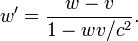
Of course that still leaves the problem of flying the pattern well, and as to that I'm counting on my friend and mentor to continue helping me along so I can advance my rather awkward attempts at the Intermediate Sequence into something a bit more polished in time for the Nats. Fortunately, even though I don't have the best of eye hand coordination, I can count on an awesome plane to help.
Did I mention I love my Delro
JP
Of course that still leaves the problem of flying the pattern well, and as to that I'm counting on my friend and mentor to continue helping me along so I can advance my rather awkward attempts at the Intermediate Sequence into something a bit more polished in time for the Nats. Fortunately, even though I don't have the best of eye hand coordination, I can count on an awesome plane to help.
Did I mention I love my Delro
JP
01-22-2010 | 05:47 PM
#160
RE: Delro E-Motion kit
If you tell your friends and mentor you want to fly well, I suspect they will tell you to put in the 30-10 EVO and go out and practice, practice, practice. That is my recommendation.
Jim
Jim
01-22-2010 | 06:21 PM
#161
Joined: Oct 2005
Posts: 609
Likes: 0
Received 0 Likes
on
0 Posts
From: pound ridge,
NY
RE: Delro E-Motion kit
I don't want to pull this thread off topic so I will point to my [link=http://www.rcuniverse.com/forum/m_9271587/anchors_9271587/mpage_1/key_/anchor/tm.htm#9271587]25-12 Thread[/link] for anyone wanting to follow the research involved in comparing the 30-10 to the 25-12. Suffice to say that my mentor agrees with my choice to keep the 25-12 in the E-Motion and I look forward to publishing the results of further research as to the motors efficacy in relation to 2M planes.
JP
JP
01-26-2010 | 09:21 PM
#162
Joined: Oct 2005
Posts: 609
Likes: 0
Received 0 Likes
on
0 Posts
From: pound ridge,
NY
RE: Delro E-Motion kit
I'm certain that most anyone reading this thread has seen my other posts regarding the 25-12, but if perchance someone missed it I will simply say that I ran the 25-12 on a 20.5x14 RASA and was "Wowed". This is "THE" combination for this plane and makes the intermediate level machine an absolute MONSTER! The RASA prop rocks and the 25-12 handles it with no problem. Having flown a Berryl and an Integral I can say without hesitation that the E-Motion is simply better. Easier to roll, slows down more, sturdier gear, and simpler to make weight. The only consideration I would offer (and I believe UAL767 may elaborate) is that the battery tray may be to short for optimal CG. Most of us prefer a more aft CG which gives a lighter touch when inverted, but the tray as it is setup in combination with the most often used power setups leads to a forward CG so adding an extension to the battery tray which enables moving your batteries aft by 1 inch or so is not a bad idea
JP
JP
03-21-2010 | 09:24 PM
#163

Thread Starter
My Feedback: (8)
Joined: Dec 2002
Posts: 1,366
Likes: 0
Received 0 Likes
on
0 Posts
From: Leesburg, VA
RE: Delro E-Motion kit
Larry test flew his #2 E-Motion today together with JR making his first flight with his Delro Addiction.. Flew exactly like his first one.
Really nice job, Larry. Congrats to both you and JR.
Really nice job, Larry. Congrats to both you and JR.
03-22-2010 | 07:22 PM
#165
Senior Member
My Feedback: (1)
Joined: Oct 2008
Posts: 197
Likes: 0
Received 0 Likes
on
0 Posts
From: Bridgewater,
VA
RE: Delro E-Motion kit
Hey got your's ready to spray on Wedensday. Saw Chris flying it yesterday cann't tell that you had the smaller motor in it. Plenty of power.
Jr
Jr
 04-06-2010 | 05:59 AM
#167
Joined: Oct 2005
Posts: 609
Likes: 0
Received 0 Likes
on
0 Posts
From: pound ridge,
NY
RE: Delro E-Motion kit
Finally got to pick up my E-Motion and bring it home, but not before a day of flyin' with the "Delro Boys". I can't get over how great it is to have a plane "professionally" built and trimmed. Thanks again to Chris, Larry, and JR for making an awesome E-Motion! Now I just hope I can practice enough to make it look like I know how to fly it the way it should be flown.
Thanks again guy,
Joe
Thanks again guy,
Joe
04-14-2010 | 07:48 PM
#169
Joined: Oct 2005
Posts: 609
Likes: 0
Received 0 Likes
on
0 Posts
From: pound ridge,
NY
RE: Delro E-Motion kit
To all you E-Motion owners,
I've been flying my plane hard for 5 days now and adjusted the wing incidence a bit more positive to remove the elevator up trim that I had plus I found that the elevator comes with a slight negative incidence on the right versus the left which, according to DaveL, is an intentional design element to counter act the left turning tendency of the props slip stream and then today I was checking my CG and found that I am happy at 195 cm aft of the leading edge which seems to me to be a bit further back than the recommended position. Also I should note that for my plane with Rhino packs which weigh 1255g (44.3 ozs) the battery packs were hanging off the back of the tray so Chris added an extension to accommodate the batteries properly.
Which brings me to my questions . . . where do you set your CG on your E-Motion? Do your batteries hang off the back slightly?
I must say, coming off the Integral as my first "real" pattern plane this plane has definitely lived up to its expectations. For the Intermediate sequence it is noticeably easier to fly than the Integral. Easier to roll, easier to stall turn, and easier to land by far. Could be I'm just more comfortable now as well, but in any case I can't say enough good things about this plane! Oh . . . and did I mention I'm flying it with the 520g Plettenberg EVO 25-12
Anyways thats it for now!
Joe
I've been flying my plane hard for 5 days now and adjusted the wing incidence a bit more positive to remove the elevator up trim that I had plus I found that the elevator comes with a slight negative incidence on the right versus the left which, according to DaveL, is an intentional design element to counter act the left turning tendency of the props slip stream and then today I was checking my CG and found that I am happy at 195 cm aft of the leading edge which seems to me to be a bit further back than the recommended position. Also I should note that for my plane with Rhino packs which weigh 1255g (44.3 ozs) the battery packs were hanging off the back of the tray so Chris added an extension to accommodate the batteries properly.
Which brings me to my questions . . . where do you set your CG on your E-Motion? Do your batteries hang off the back slightly?
I must say, coming off the Integral as my first "real" pattern plane this plane has definitely lived up to its expectations. For the Intermediate sequence it is noticeably easier to fly than the Integral. Easier to roll, easier to stall turn, and easier to land by far. Could be I'm just more comfortable now as well, but in any case I can't say enough good things about this plane! Oh . . . and did I mention I'm flying it with the 520g Plettenberg EVO 25-12
Anyways thats it for now!
Joe
04-14-2010 | 09:34 PM
#170
RE: Delro E-Motion kit
I too have been flying the crap out of my E-Motion and loving it!
I never moved the wing incidence from the +.75deg that Chris had recommended. Stab at zero with nearly now elevator trim.
My CG is at 195 - I just like how the plane rolls with an aft CG. Snaps and spins are still OK.
My batteries hand about 2" off the back of the tray. I've got double velco straps anchored over the landing gear.
My only negative on this plane is the large amount of Rud-Ail mix required. Seems like they got the dihedral wrong?
Dan
I never moved the wing incidence from the +.75deg that Chris had recommended. Stab at zero with nearly now elevator trim.
My CG is at 195 - I just like how the plane rolls with an aft CG. Snaps and spins are still OK.
My batteries hand about 2" off the back of the tray. I've got double velco straps anchored over the landing gear.
My only negative on this plane is the large amount of Rud-Ail mix required. Seems like they got the dihedral wrong?
Dan
04-15-2010 | 07:32 PM
#171
Joined: Oct 2005
Posts: 609
Likes: 0
Received 0 Likes
on
0 Posts
From: pound ridge,
NY
RE: Delro E-Motion kit
Hey Dan,
Great to hear I'm not goin' to crazy with my preference for an aft CG. As a counter point I would say I ran into the obvious today when flying around in 15 knot gusty winds. The plane seemed to bounce around more than I wanted so I tried moving my battery back significantly from its normal postion, and, of course, found that it tracked in the wind much better with a more forward CG. The truly surprising part was that the roll didn't change enough so that I noticed so I'm thinkin' I may change my mind and try a slightly more forward CG for awhile. When I got home and measured it was around 187 for the new CG.
Anyways still glad to hear I'm not too far off with what other folks are using. I wish I could speak more to the rudder-aileron mix needed. Unfortunately I have the mix on my radio as well, but it was all the work of Chris so I can't say much about it. Looks like I have my homework cut out for me for next week
Thanks,
Joe
Great to hear I'm not goin' to crazy with my preference for an aft CG. As a counter point I would say I ran into the obvious today when flying around in 15 knot gusty winds. The plane seemed to bounce around more than I wanted so I tried moving my battery back significantly from its normal postion, and, of course, found that it tracked in the wind much better with a more forward CG. The truly surprising part was that the roll didn't change enough so that I noticed so I'm thinkin' I may change my mind and try a slightly more forward CG for awhile. When I got home and measured it was around 187 for the new CG.
Anyways still glad to hear I'm not too far off with what other folks are using. I wish I could speak more to the rudder-aileron mix needed. Unfortunately I have the mix on my radio as well, but it was all the work of Chris so I can't say much about it. Looks like I have my homework cut out for me for next week
Thanks,
Joe
04-16-2010 | 07:45 AM
#172
RE: Delro E-Motion kit
Thanks for the tip on the CG Joe. My plane was bouncing and wandering last weekend and I dismissed it as bumpy air. I'll try the more forward CG.
Dan
Dan
04-20-2010 | 01:53 PM
#173
Joined: Oct 2005
Posts: 609
Likes: 0
Received 0 Likes
on
0 Posts
From: pound ridge,
NY
RE: Delro E-Motion kit
Yesterday flew in horrible winds and today I got my pay back as the weather was perfect and the wind just barely a gentle breeze. Used every pack I had and wished I had more . I'm beginning to think the battery tray extension that I had Chris build was unnecessary. I really am curious to see if Larry has taken a CG reading on his 'cuz I'd love to know how it works out with a heavier motor in terms of battery weight and position. Added a couple more degrees of down elevator to the Throttle-Elevator mix on idle throttle. Seems to be just perfect now in the downlines, although I'm beginning to become increasingly curious about experimenting with braking on a calm day just to see if I can tell the difference. Clearly my plane picks up speed in the downline, but so does most every other plane I have seen. I realize braking is more like Ph. D. work rather than the basic practice I should be focusing on, but just curious as always.
Anyways, just thought I'd share some pics and thoughts from the day for my fellow E-Motion-nal types
Joe
. I'm beginning to think the battery tray extension that I had Chris build was unnecessary. I really am curious to see if Larry has taken a CG reading on his 'cuz I'd love to know how it works out with a heavier motor in terms of battery weight and position. Added a couple more degrees of down elevator to the Throttle-Elevator mix on idle throttle. Seems to be just perfect now in the downlines, although I'm beginning to become increasingly curious about experimenting with braking on a calm day just to see if I can tell the difference. Clearly my plane picks up speed in the downline, but so does most every other plane I have seen. I realize braking is more like Ph. D. work rather than the basic practice I should be focusing on, but just curious as always.Anyways, just thought I'd share some pics and thoughts from the day for my fellow E-Motion-nal types
Joe
04-21-2010 | 07:03 AM
#174
Joined: Jan 2003
Posts: 99
Likes: 0
Received 0 Likes
on
0 Posts
From: VA
RE: Delro E-Motion kit
Joe,
My CG is more forward than yours. By looking at your picture you included of the extension area for the battery mount I can tell you are running a much more negative cg. I did add an extension but much less in length. Using a Rhino 4900 when practicing I locate the end of the battery (end with wires) 1/4 inch from the back landing gear fuse honey-cone support. When flying the plane needs only a touch of down when inverted and on a 45 up line will not change tracking when rolling to inverted. Slow rolls and 4 points require very little rudder. Down lines are straight with a 2% mix. In the wind which we had plenty of this last weekend at Myrtle Beach it tracks very well especially if you use that left stick.
My CG is more forward than yours. By looking at your picture you included of the extension area for the battery mount I can tell you are running a much more negative cg. I did add an extension but much less in length. Using a Rhino 4900 when practicing I locate the end of the battery (end with wires) 1/4 inch from the back landing gear fuse honey-cone support. When flying the plane needs only a touch of down when inverted and on a 45 up line will not change tracking when rolling to inverted. Slow rolls and 4 points require very little rudder. Down lines are straight with a 2% mix. In the wind which we had plenty of this last weekend at Myrtle Beach it tracks very well especially if you use that left stick.
04-28-2010 | 07:00 PM
#175
Senior Member
RE: Delro E-Motion kit
ORIGINAL: 2Sunny
Yesterday flew in horrible winds and today I got my pay back as the weather was perfect and the wind just barely a gentle breeze. Used every pack I had and wished I had more. I'm beginning to think the battery tray extension that I had Chris build was unnecessary. I really am curious to see if Larry has taken a CG reading on his 'cuz I'd love to know how it works out with a heavier motor in terms of battery weight and position. Added a couple more degrees of down elevator to the Throttle-Elevator mix on idle throttle. Seems to be just perfect now in the downlines, although I'm beginning to become increasingly curious about experimenting with braking on a calm day just to see if I can tell the difference. Clearly my plane picks up speed in the downline, but so does most every other plane I have seen. I realize braking is more like Ph. D. work rather than the basic practice I should be focusing on, but just curious as always.
Anyways, just thought I'd share some pics and thoughts from the day for my fellow E-Motion-nal types
Joe
Yesterday flew in horrible winds and today I got my pay back as the weather was perfect and the wind just barely a gentle breeze. Used every pack I had and wished I had more
. I'm beginning to think the battery tray extension that I had Chris build was unnecessary. I really am curious to see if Larry has taken a CG reading on his 'cuz I'd love to know how it works out with a heavier motor in terms of battery weight and position. Added a couple more degrees of down elevator to the Throttle-Elevator mix on idle throttle. Seems to be just perfect now in the downlines, although I'm beginning to become increasingly curious about experimenting with braking on a calm day just to see if I can tell the difference. Clearly my plane picks up speed in the downline, but so does most every other plane I have seen. I realize braking is more like Ph. D. work rather than the basic practice I should be focusing on, but just curious as always.Anyways, just thought I'd share some pics and thoughts from the day for my fellow E-Motion-nal types
Joe
BTW, FWIW2U, I had a 12 X problem with TX shutting off at high and low low rate elevator. It would only turn on and stay on on mid rate elevator. Weird. It was fixed but it was the strangest thing that has happened to my JR equipment in 30 years of flying JR.
Before folks start to chime in about switching, forget about it!! I flew the other brand for 20 flights, destroying one of the best pattern planes I ever built, in the process. I won't switch if they gave me their stuff free. That was 31 years ago and still think about it

