


Electronic solutions to modifying glow engines of all sizes to gasoline
 07-22-2022 | 08:51 AM
#226


I found the reference to that VPP at model airplane new website, its not the full article... there were video links of it flying 3D maneuvers hovering in the vertical nose down position..
https://www.modelairplanenews.com/va...itch-gas-prop/
https://www.modelairplanenews.com/va...itch-gas-prop/
 07-22-2022 | 09:29 PM
#227


My Feedback: (1)
Here's the formula from Walbro's service manual.
D = K x Square Root(C x n)
where:
D=venturi diameter, in millimeters
K= constant between 0.65 and 0.90 (determines the smaller and the biggest diameter to be tested at the specific engine)
C=cylinder displacement, in cubic centimeters
n=RPM at peak power/1.000
D = K x Square Root(C x n)
where:
D=venturi diameter, in millimeters
K= constant between 0.65 and 0.90 (determines the smaller and the biggest diameter to be tested at the specific engine)
C=cylinder displacement, in cubic centimeters
n=RPM at peak power/1.000
ran the numbers in the equation John provided and here are the results - I think "n" has to be RPM/1000 to work.
given a 7mm bore that I'm using, the K factor comes out to 0.74 which is mid range.(at 12,000 rpm)
the 7mm bore shows a rpm range of 8,000 to 15,400 given the K factor range provided....
As planned I'm going to prop down to see what effect that has...
07-22-2022 | 11:18 PM
#228
ran the numbers in the equation John provided and here are the results - I think "n" has to be RPM/1000 to work.
given a 7mm bore that I'm using, the K factor comes out to 0.74 which is mid range.(at 12,000 rpm)
the 7mm bore shows a rpm range of 8,000 to 15,400 given the K factor range provided....
As planned I'm going to prop down to see what effect that has...
given a 7mm bore that I'm using, the K factor comes out to 0.74 which is mid range.(at 12,000 rpm)
the 7mm bore shows a rpm range of 8,000 to 15,400 given the K factor range provided....
As planned I'm going to prop down to see what effect that has...
Those engines typically are operated with an 11 x 6 prop, and they spin some 12K with that, a bit higher in flight.
With an 11 x 6 while burning gas, it "kinda works" but is pretty sensitive and "wiggling the needle within the same click of the ratchet" can allready make a difference. With that prop, ground RPM is about 11K or slightly below
I changed to an 11 x 5, which brought the RPM back up in the 12~12,5K range on the ground, and that restored adjustability. It still is sensitive allright, but that's the nature of the fuel (if you are going to burn half the volume of fuel compared to methanol, it is logic that one click has the same effect as 2 clicks on methanol, right?)
Same with my ASP 30 FS, which typically runs an 11 x 5 or 10 x 6 on methanol, but on gas feels happiest with 10 x 5, or the 91 FS that feels happy with a 14 x 6 on gas where it would like a 15 x 6 on glow.
A rare exception is the 52FS, which seems happier overall with a 12 x 6 even on gasoline. I am not quite sure why it does that. It runs very well with an 11 x 6 and is more powerful with that prop, but somehow it just runs "nicer" with the 12 x 6 and I cannot put my finger on it as to why.
So it is not a rule set in stone, but still more often than not, that a lighter prop improves things. Lighter props however, increase RPM, therefore power, therefore heat production, so you have to find the proper compromise (and maybe that is why the 52 seems happier with the heavy prop).
I did not run the equation, because I do not have the intake diameters on any of those engines at hand...

The following users liked this post:
Jesse Open (02-06-2023)
The following users liked this post:
Jesse Open (02-06-2023)
07-24-2022 | 03:39 PM
#231
 that looks complicated
Why move the whole prop and motor fighting gyroscopic forces?
Those blades look a lot like standard 450 (ish) rotor blades so why not just use a swashplate / rotorhead setup?
Sure you need a longer axle and a kind of secondary firewall to mount the servos but the resulting setup will be much more faster and accurate then moving a spinning motor and prop disk.
Also then with a flight controller you could have hands off (inverted) hover and all the other things helies can these days.
Here is a crazy idea; take the main gear of a trex 600n,the bearing blocks and head (flybarless dfc version) and then drive that gear by 3 .30 heli engines.
A pair of these on a "Vought V-173" and you can do some seriously crazy stuff.
6 engines controlled by governors on tuned pipes (becouse why not would make a intersting sound
Those blades look a lot like standard 450 (ish) rotor blades so why not just use a swashplate / rotorhead setup?
Sure you need a longer axle and a kind of secondary firewall to mount the servos but the resulting setup will be much more faster and accurate then moving a spinning motor and prop disk.
Also then with a flight controller you could have hands off (inverted) hover and all the other things helies can these days.
Here is a crazy idea; take the main gear of a trex 600n,the bearing blocks and head (flybarless dfc version) and then drive that gear by 3 .30 heli engines.
A pair of these on a "Vought V-173" and you can do some seriously crazy stuff.
6 engines controlled by governors on tuned pipes (becouse why not
would make a intersting sound
07-25-2022 | 06:32 PM
#233
My Feedback: (1)
We are in holidays for a couple of weeks ( beautiful Northern Canadian Lake) and having fun, but missing my shop and my engines to play with... Lots of time to relax and reading time. Spent a bit of time "reviewing" this project as I was rearranging some files on my computer - Some great things have happened here..
07-26-2022 | 07:58 AM
#235
Ooh, its just something of interest while the thread is at idle, no harm done... your comments regarding the centripetal forces got me intrigued, as I do recall seeing them in action.... fascinating minds we out there, a guy machined his own counter rotating VPP system for his Westland Wyvern, electric of course... its the talented individuals we have in this hobby that drives it forward with these innovative ideas.
The following users liked this post:
Jesse Open (02-06-2023)
07-26-2022 | 09:39 AM
#236
 arduino ide pi support?
This might be "old news" but just found out that the arduino ide supports the pico pi microcontroller.
Does this mean that the code should work ? (after recompiling)
Got 2 "standard" pico's on the way and a 3rd with the wifi module to learn/ play with.
Does this mean that the code should work ? (after recompiling)
Got 2 "standard" pico's on the way and a 3rd with the wifi module to learn/ play with.
The following users liked this post:
Jesse Open (02-06-2023)
07-26-2022 | 10:04 AM
#237
So please come in guys!
The following users liked this post:
Jesse Open (02-06-2023)
07-26-2022 | 12:44 PM
#238
code is only the beginning
The pico pi works on 3.3 volts and as far as i understands also expects the "outside world" to comunicate with it on 3.3v instead of the 5v used by our recievers and servo's.
So for the "proof of concept" experiments a "level shifter"? chip (3.3 in/ 5 out) might be needed.
If eventionally it works it might be practical to design a circuit board and get a batch from the likes of pcb-way to create a single board unit.
Have acces to smd assambly equipment (and the people who know how to use it) so could make a full intergrated smd version.
First lets se how long it takes for these pi's to arive..
So for the "proof of concept" experiments a "level shifter"? chip (3.3 in/ 5 out) might be needed.
If eventionally it works it might be practical to design a circuit board and get a batch from the likes of pcb-way to create a single board unit.
Have acces to smd assambly equipment (and the people who know how to use it) so could make a full intergrated smd version.
First lets se how long it takes for these pi's to arive..
The following users liked this post:
Jesse Open (02-06-2023)
07-26-2022 | 04:11 PM
#239

The pico pi uses the same processor so the code should be close but I would expect the timer configuration section at the top of the code would require a bit of tweaking because of the different board wiring. Nothing more than a few minutes of work. Why did you want to switch boards?
The following 2 users liked this post by John_M_:
Fxdr (10-14-2024),
Jesse Open (02-06-2023)
07-27-2022 | 09:41 AM
#241
Just practical reasons. They are easy to get for me and relative cheap.
Also i already own several other pi; A 4 as octoprint (3d printer) server a 400 as general media player and a 3 with the 7 inch tutchscreen that i try to get retropi running on. This is most user level and there is still much to learn.
So using the pico looks like a logical thing to do.
Also i already own several other pi; A 4 as octoprint (3d printer) server a 400 as general media player and a 3 with the 7 inch tutchscreen that i try to get retropi running on. This is most user level and there is still much to learn.
So using the pico looks like a logical thing to do.
07-27-2022 | 09:55 AM
#242
great scott
Aready added the pico to the arduino ide board manager so in theory it should be able to send a program to the pi now.
The plan is to mount one on a breadboard and see if i can make a led blink and then slowely build from there

The following users liked this post:
Jesse Open (02-06-2023)
07-27-2022 | 01:13 PM
#244
I like the seeeduino XIAO RP2040... the arduino compatible Pico is even smaller, but only runs 16mhz.. It must be a fairly recent release, not a lot of info on it.
https://www.tindie.com/products/mell...ble-dev-board/
https://www.tindie.com/products/mell...ble-dev-board/
Last edited by John_M_; 07-27-2022 at 01:20 PM.
The following users liked this post:
Jesse Open (02-06-2023)
07-31-2022 | 07:39 PM
#245
My Feedback: (1)
Soooo.... been quiet while I was on holidays.. 
Had a great time and was a relaxing break. Got some time to do a bit of thinking and figuring and hope to get a bit of shop time to try a few things.
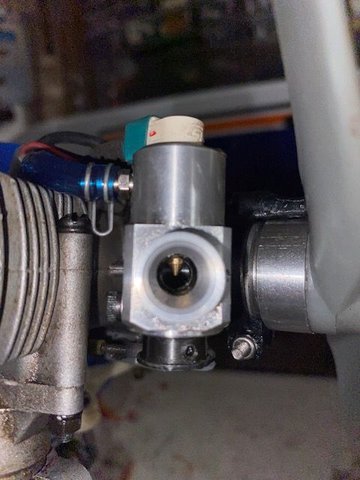
First - I spent some time thinking about the Venturi area of the TBI carb - THEORETICALLY.. it was a bit big based on the measurements of 0.40/0.45 size carbs I have on hand. With the lack of a full span spray bar it had as much area as the stock ST carb (big) and more than a 4D OS carb. As a quick trial I have built a Delrin insert and squeezed it down to 5.7mm which I scientifically calculated using a very complicated formula. Actually just an average of .40 size carbs I have and deduct about 15% for the conversion to gas.. Hope to get a chance to test and tune tomorrow to see what it changes. I had no shortage of top end with the setup and would even give up a bit to make it easier to tune a solid in air mixture that is not overly rich on the ground. If it doesn't work - I can pop the restrictor out and return to normal.
Second - I have put some more thought into the "pressure regulator" and have some ideas on that - I have to complete the test piece and try it out - that will be my next effort.
Stay tuned....

Had a great time and was a relaxing break. Got some time to do a bit of thinking and figuring and hope to get a bit of shop time to try a few things.
First - I spent some time thinking about the Venturi area of the TBI carb - THEORETICALLY.. it was a bit big based on the measurements of 0.40/0.45 size carbs I have on hand. With the lack of a full span spray bar it had as much area as the stock ST carb (big) and more than a 4D OS carb. As a quick trial I have built a Delrin insert and squeezed it down to 5.7mm which I scientifically calculated using a very complicated formula.
Actually just an average of .40 size carbs I have and deduct about 15% for the conversion to gas.. Hope to get a chance to test and tune tomorrow to see what it changes. I had no shortage of top end with the setup and would even give up a bit to make it easier to tune a solid in air mixture that is not overly rich on the ground. If it doesn't work - I can pop the restrictor out and return to normal. Second - I have put some more thought into the "pressure regulator" and have some ideas on that - I have to complete the test piece and try it out - that will be my next effort.
Stay tuned....
08-01-2022 | 07:33 PM
#247
My Feedback: (1)
Success...
So.... Tried the skinny Venturi mod on the ST .45 setup and it made a huge difference in handling - No other changes required other than a moderate retune which seemed to mostly affect the top end (needed to lean)- The large flat spot the top is now gone and the idle is much improved - The biggest change is tunabiity as the mixture control is no longer critical and very easy to set. I did lose a bit of performance I think but its hard to estimate as it was relatively hot today - I showed 11,300 on a 10/8 today and I think I ran 11,800 or 11,900 on previous occasions (cooler) - I'm going to leave the power "test" to how it feels flying.
I can tell that I will not have to set up overly rich on takeoff with this setup, as was the case before - and I can also tell that tuning will be greatly simplified as there is not a spot in the range that shows critical adjustments any longer.
Here is the comparison of the resulting curve - Without and with Insert.
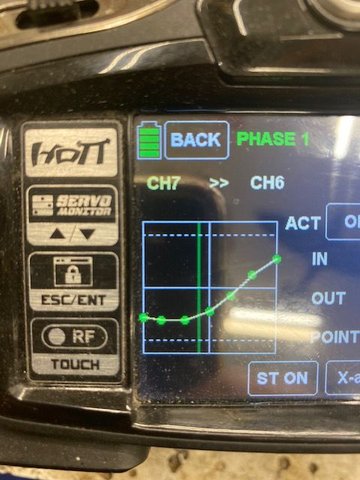
Previous setup - Big bore
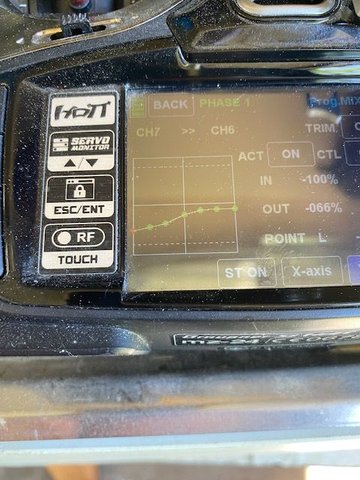
Skinny Venturi
I can tell that I will not have to set up overly rich on takeoff with this setup, as was the case before - and I can also tell that tuning will be greatly simplified as there is not a spot in the range that shows critical adjustments any longer.
Here is the comparison of the resulting curve - Without and with Insert.
Previous setup - Big bore
Skinny Venturi
08-01-2022 | 11:01 PM
#248
Wow... that is a significant difference. I'd say super result. And if the power loss is an issue, we can fix that "the American way": There's no substitute for cubic inches (although in all fairness, I believe that the origin of those and similar quotes has to be contributed to Enzo Ferrari, who said that it is always advisable to have more horsepower than the competition...)
08-02-2022 | 05:02 AM
#249
My Feedback: (1)
This is a bit of an eyeopener as it "changes the game" a bit if we are making a simple TBI carb to fit an engine - We can make it smaller and "accept the losses" for ease of handling and setup. No need to get into fancy pumps or regulators as I think i'm going to find this thing will now run great as is.
This ST in its previous form with the 7mm carb never really lost any power in my estimation - It preformed like a good strong .40 on glow (or even a .45), albeit at the expense of ease of handling. I think we have all run some "powerhouse" engines that made tons of power but were on the finicky side. With the skinnier venturi, the "expected theoretical" power loss is there but the ease of Handling comes back.
things I noticed immediately:
1. Mixture setting was noticeably less critical - 1 "click" on my mix curve produced reactions that had me wishing for a 1/2 click option - Now it takes 5 clicks to produce the same result.
2. the engine can run at full power (static) Without showing signs of heating - even at "leanish" settings - Previously I had to keep the mixture overly rich to keep the heat in check statically.
You are correct Bert - Cubic inches can solve this equation - Like a .50 on gas = a .40 on glow.
The original system of an unmodified carb and inline solenoid still trumps for ease of setup and availability but if we go to lengths to produce a "simple carb" - I think we can make it better by getting the size correct.
Hope to get out flying this week to see if the in air performance mimics the "***** cat" this has become on the ground.
Edit: I guess you can't say "puszy"
This ST in its previous form with the 7mm carb never really lost any power in my estimation - It preformed like a good strong .40 on glow (or even a .45), albeit at the expense of ease of handling. I think we have all run some "powerhouse" engines that made tons of power but were on the finicky side. With the skinnier venturi, the "expected theoretical" power loss is there but the ease of Handling comes back.
things I noticed immediately:
1. Mixture setting was noticeably less critical - 1 "click" on my mix curve produced reactions that had me wishing for a 1/2 click option - Now it takes 5 clicks to produce the same result.
2. the engine can run at full power (static) Without showing signs of heating - even at "leanish" settings - Previously I had to keep the mixture overly rich to keep the heat in check statically.
You are correct Bert - Cubic inches can solve this equation - Like a .50 on gas = a .40 on glow.
The original system of an unmodified carb and inline solenoid still trumps for ease of setup and availability but if we go to lengths to produce a "simple carb" - I think we can make it better by getting the size correct.
Hope to get out flying this week to see if the in air performance mimics the "***** cat" this has become on the ground.
Edit: I guess you can't say "puszy"
Last edited by Cat 1; 08-02-2022 at 05:06 AM.

