


Silver Swallow Pulldown
 06-29-2011 | 01:47 AM
#1
Thread Starter

Joined: Oct 2005
Posts: 396
Likes: 0
Received 0 Likes
on
0 Posts
From: ACTAustralia, AUSTRALIA
 Silver Swallow Pulldown
I was flabergasted , it has a circular counterweight , no attempt to balance and a really thick piston , it ran OK , but I will try a rebuild , and hope for the best , now can you make a piston from very hard wood ?
What is the ignition temperature of Jarrah
What is the ignition temperature of Jarrah
 06-29-2011 | 02:07 AM
#2
My Feedback: (1)
RE: Silver Swallow Pulldown
I don't know if you can successfully make a piston out of timber, however towards the end of WW2 in the Pacific, the Japanese were reduced to trying to replace Aircraft engine ball bearings with oil impregnated hardwood solid bearings which sort of worked. The idea isn't as looney as it seems because the shaft bearings in ships were similarly made right up to the modern era.
Ray
Ray
06-29-2011 | 04:27 AM
#6
My Feedback: (1)
RE: Silver Swallow Pulldown
I wasn't being serious! Wood and Carbon Fibre, even HT stuff, has exactly the wrong properties to make into a piston. The engine probably has a Steel liner, only a cast iron piston would work with it 'cause they have similar expansion coefficients. There are people around eastern OZ who will make and fit a new piston and contra to your engine for a little money. PM me if you want some names.
Ray.
Ray.
06-29-2011 | 10:14 AM
#7
 RE: Silver Swallow Pulldown
Maybe if the piston has the room for it you could cut a ring groove in it. Or why not make a aluminum piston and put in a piston ring.
I got to thinking about cutting a ring groove in a few pistons for some DEEZIL engines I have and either making or get made some piston rings to fit and see if the engines would run OK or not. As it is the pistons are a bit too loose in the cylinders. The Deezil engines have really tall or long pistons, one could likely put on two rings on them if they really wanted to.
You know, the Russians are getting really good with ceramics. They have been making ceramic coated cylinders for engines for a while now, but I was surprised to see they are making ceramic wrist pins for the engines now too. The Cyclon engine folks are the ones doing it too with their engines. I wonder how well a ceramic piston would hold up.
Wood piston. That might be interesting. Maybe use some of that really hard wood that comes out of Africa or someplace, and soak it in superglue for a while to maybe toughen it up even more. or maybe pressure inject it with high temperature epoxy resin.

I got to thinking about cutting a ring groove in a few pistons for some DEEZIL engines I have and either making or get made some piston rings to fit and see if the engines would run OK or not. As it is the pistons are a bit too loose in the cylinders. The Deezil engines have really tall or long pistons, one could likely put on two rings on them if they really wanted to.
You know, the Russians are getting really good with ceramics. They have been making ceramic coated cylinders for engines for a while now, but I was surprised to see they are making ceramic wrist pins for the engines now too. The Cyclon engine folks are the ones doing it too with their engines. I wonder how well a ceramic piston would hold up.
Wood piston. That might be interesting. Maybe use some of that really hard wood that comes out of Africa or someplace, and soak it in superglue for a while to maybe toughen it up even more. or maybe pressure inject it with high temperature epoxy resin.
06-29-2011 | 11:48 AM
#8
 RE: Silver Swallow Pulldown
ORIGINAL: earlwb
Maybe if the piston has the room for it you could cut a ring groove in it. Or why not make a aluminum piston and put in a piston ring.
I got to thinking about cutting a ring groove in a few pistons for some DEEZIL engines I have and either making or get made some piston rings to fit and see if the engines would run OK or not. As it is the pistons are a bit too loose in the cylinders. The Deezil engines have really tall or long pistons, one could likely put on two rings on them if they really wanted to.
You know, the Russians are getting really good with ceramics. They have been making ceramic coated cylinders for engines for a while now, but I was surprised to see they are making ceramic wrist pins for the engines now too. The Cyclon engine folks are the ones doing it too with their engines. I wonder how well a ceramic piston would hold up.
Wood piston. That might be interesting. Maybe use some of that really hard wood that comes out of Africa or someplace, and soak it in superglue for a while to maybe toughen it up even more. or maybe pressure inject it with high temperature epoxy resin.
Maybe if the piston has the room for it you could cut a ring groove in it. Or why not make a aluminum piston and put in a piston ring.
I got to thinking about cutting a ring groove in a few pistons for some DEEZIL engines I have and either making or get made some piston rings to fit and see if the engines would run OK or not. As it is the pistons are a bit too loose in the cylinders. The Deezil engines have really tall or long pistons, one could likely put on two rings on them if they really wanted to.
You know, the Russians are getting really good with ceramics. They have been making ceramic coated cylinders for engines for a while now, but I was surprised to see they are making ceramic wrist pins for the engines now too. The Cyclon engine folks are the ones doing it too with their engines. I wonder how well a ceramic piston would hold up.
Wood piston. That might be interesting. Maybe use some of that really hard wood that comes out of Africa or someplace, and soak it in superglue for a while to maybe toughen it up even more. or maybe pressure inject it with high temperature epoxy resin.
No amount of impregnation will permeate the oily dense woods like Ipé, Cumaru, or Jarrah. As a test, my old boss took a chunk of Ipé (kiln dried tongue & grooved flooring) and put it in a bucket of water for an hour. After that hour, it had the same moisture content as it did before the dunk. (5% moisture) Once sanded, if not sealed in short order the oils in the wood come to the surface. I dont think you would need to "seal" this stuff, its basically self-lubricating.
I would think a piece of endgrain Ipé with a ring would probably work rather well for awhile. Dont know about a tapered bore though.
(I've been a hardwood flooring install/finish guy for 12 years)
06-29-2011 | 12:32 PM
#10
RE: Silver Swallow Pulldown
ORIGINAL: earlwb
Cool. That might make for a interesting experiment.
Cool. That might make for a interesting experiment.
06-29-2011 | 01:04 PM
#11
 RE: Silver Swallow Pulldown
Quite interesting wonder what the MLE (mean life expectancy) would be I would think minutes martin
but would raise some eyebrows
I think the wrist pin area of the piston would get loose quick
but would raise some eyebrows
I think the wrist pin area of the piston would get loose quick
06-29-2011 | 02:12 PM
#13
RE: Silver Swallow Pulldown
123Cat== wood petrified might do it just do not get caught taking it martin
then again I have fossil horse tooth equine sp pleistocene epoch 1 to2 millon years old source hillsborough county fl pretty soild but am keeping it
then again I have fossil horse tooth equine sp pleistocene epoch 1 to2 millon years old source hillsborough county fl pretty soild but am keeping it
06-29-2011 | 03:14 PM
#14
RE: Silver Swallow Pulldown
ORIGINAL: 123Cat
Is lignum Vitea , wood ?
also a wood piston could be a fire hazard , and its not good to support the illegal timber trade
Is lignum Vitea , wood ?
also a wood piston could be a fire hazard , and its not good to support the illegal timber trade
A wood piston could be a fire hazard, but not likely to burn much if the right specie is used. I've tried burning saw dust and sanding dust from Spotted Gum flooring (a greasy Australian specie) and it would not burn very well at all when compared to burning sawdust from a domestic wood like oak or maple. Totally different animal.
Ironwood or Lignum Vitae is about the same hardness as Ipé. I'd assume based on its description that its a greasy wood like most other South American/Central American species.
I think it would work as a piston - As far as the wristpin goes I could press-fit the pin in the would-be wooden piston with teflon caps on the ends.
If I had access to an endmill, I would cut a piston and try it in my old Fox .40 series V since the piston and sleeve are wore out and parts are not available for it anymore.
I'm really curious to do something like this just for S&G's but alas, my tool stash is lacking...
06-29-2011 | 03:26 PM
#15
Senior Member
Joined: Oct 2009
Posts: 1,346
Likes: 0
Received 5 Likes
on
5 Posts
From: SydneyNew South wales, AUSTRALIA
RE: Silver Swallow Pulldown
ORIGINAL: 123Cat
I was flabergasted , it has a circular counterweight , no attempt to balance and a really thick piston , it ran OK , but I will try a rebuild , and hope for the best , now can you make a piston from very hard wood ?
What is the ignition temperature of Jarrah
I was flabergasted , it has a circular counterweight , no attempt to balance and a really thick piston , it ran OK , but I will try a rebuild , and hope for the best , now can you make a piston from very hard wood ?
What is the ignition temperature of Jarrah
Anyway the full circle crank web can be dealt with very easily by scalloping out the metal either side of the crank pin and I am wondering if simply shortening the piston skirt for lightening might work, sub piston induction aside.
06-29-2011 | 04:43 PM
#16
RE: Silver Swallow Pulldown
ORIGINAL: Recycled Flyer
The ignition temperature of Jarrah hard wood is 425ºC but what wood worry me more is its coefficient of friction outside of a low temperature heavily greased environment.
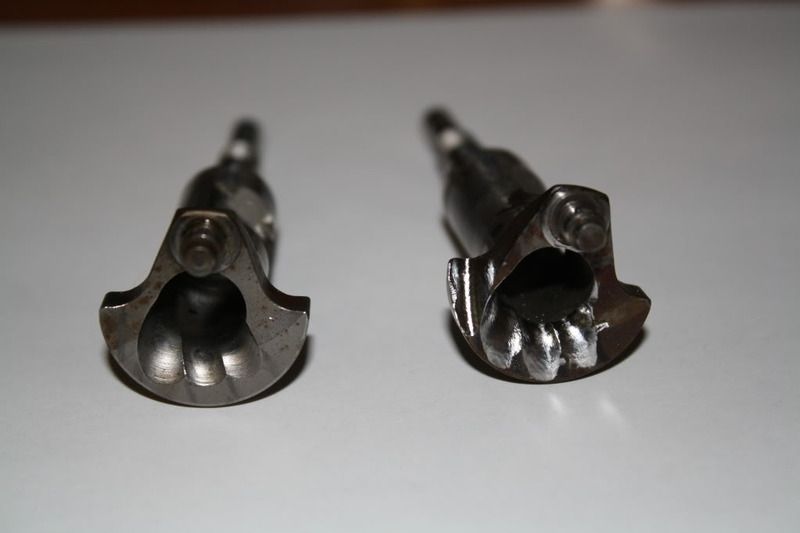
Anyway the full circle crank web can be dealt with very easily by scalloping out the metal either side of the crank pin and I am wondering if simply shortening the piston skirt for lightening might work, sub piston induction aside.
ORIGINAL: 123Cat
I was flabergasted , it has a circular counterweight , no attempt to balance and a really thick piston , it ran OK , but I will try a rebuild , and hope for the best , now can you make a piston from very hard wood ?
What is the ignition temperature of Jarrah
I was flabergasted , it has a circular counterweight , no attempt to balance and a really thick piston , it ran OK , but I will try a rebuild , and hope for the best , now can you make a piston from very hard wood ?
What is the ignition temperature of Jarrah
Anyway the full circle crank web can be dealt with very easily by scalloping out the metal either side of the crank pin and I am wondering if simply shortening the piston skirt for lightening might work, sub piston induction aside.
Crank on the left is stock, The one on the right I modified slightly. The engine gained about 500rpm from this mod. I have some more changes to make on the crank so it balances better. There was no difference in engine vibrations stock vs. modified.
 07-01-2011 | 04:25 AM
#18
Thread Starter
Joined: Oct 2005
Posts: 396
Likes: 0
Received 0 Likes
on
0 Posts
From: ACTAustralia, AUSTRALIA
RE: Silver Swallow Pulldown
so far , a 2 mm increase in stroke to bring it to 1.75 cc and a bigger gas passage and a 19 dia crank counterweight instead of 17.1, I will cut some from the pin side of the crank to try and balance a bit and a 3mm wrist pin instead of a 4mm in the piston , the stroke is bigger than the bore now , I dont know how that will affect it ?
07-01-2011 | 03:27 PM
#20
RE: Silver Swallow Pulldown
A thing to note about 'diesels':
The combustion impulse is different from both methanol and gasoline based fuels. Combustion timing is directly controllable by, first, the balance of compression and mixture settings, and somewhat less by prop and fuel selection.
Most 'sport' diesels I've run and seen run were able to find a "sweet spot" setting with much reduced vibration compared to higher/lower compressed, and/or richer/leaner settings. That setting seems suitable for sport flying, and (on decent fuel) was quite dependable.
My interpretation: The dynamics of the combustion impulse interact with the "native" metal-bits vibration tendencies. This often reduces the need to tinker with things like shaft balalnce, counterweights, etc. Special purpose, high-RPM 'diesels,' of course, are another beast entirely.
The ChiCom Silver Swallows were (are, as CS, with updated tooling) mainly sport-use engines. A bit noisy, due to the type of exhaust and bypass porting... But, still, very useful for the intended purpose. That purpose was, originally, training machinists, btw. Useful, without great internal tinkering. They are not high performance engines, but still nicely strong, and serve well, once you learn to find the "sweet spot" and fly with it.
Like the Fox 35 in this one narrow way: Both engines were designed to be "centered" and very tolerant of QC while still capable of their intended purpose. Some recent CS .15s (Silver Swallow, the next generation) were far better made than the original batch of Silver Swallows - which means only that a longer and more conscientious break-in may be required for best use. Neither 'generation' is/were Kleenex engines (to use once, then toss).
These engines can be well worth their price if we learn how to use them for their intended purposes. Silver Swallows, old and new, and Fox 35s still can do what they were meant to do. ...If we let them...
The combustion impulse is different from both methanol and gasoline based fuels. Combustion timing is directly controllable by, first, the balance of compression and mixture settings, and somewhat less by prop and fuel selection.
Most 'sport' diesels I've run and seen run were able to find a "sweet spot" setting with much reduced vibration compared to higher/lower compressed, and/or richer/leaner settings. That setting seems suitable for sport flying, and (on decent fuel) was quite dependable.
My interpretation: The dynamics of the combustion impulse interact with the "native" metal-bits vibration tendencies. This often reduces the need to tinker with things like shaft balalnce, counterweights, etc. Special purpose, high-RPM 'diesels,' of course, are another beast entirely.
The ChiCom Silver Swallows were (are, as CS, with updated tooling) mainly sport-use engines. A bit noisy, due to the type of exhaust and bypass porting... But, still, very useful for the intended purpose. That purpose was, originally, training machinists, btw. Useful, without great internal tinkering. They are not high performance engines, but still nicely strong, and serve well, once you learn to find the "sweet spot" and fly with it.
Like the Fox 35 in this one narrow way: Both engines were designed to be "centered" and very tolerant of QC while still capable of their intended purpose. Some recent CS .15s (Silver Swallow, the next generation) were far better made than the original batch of Silver Swallows - which means only that a longer and more conscientious break-in may be required for best use. Neither 'generation' is/were Kleenex engines (to use once, then toss).
These engines can be well worth their price if we learn how to use them for their intended purposes. Silver Swallows, old and new, and Fox 35s still can do what they were meant to do. ...If we let them...
07-01-2011 | 03:41 PM
#21
Thread Starter
Joined: Oct 2005
Posts: 396
Likes: 0
Received 0 Likes
on
0 Posts
From: ACTAustralia, AUSTRALIA
RE: Silver Swallow Pulldown
I was a bit surprised that crank fitted in,,,,,,,, its much bigger and Ive got the cyl honed with a pretty steep taper , that maybe bad,,,,,, and I was thinking of a longer rod ( about 8mm ) to reduce the piston acceleration I will use a Viton O ring in cast contra piston,
07-02-2011 | 04:53 AM
#22
Thread Starter
Joined: Oct 2005
Posts: 396
Likes: 0
Received 0 Likes
on
0 Posts
From: ACTAustralia, AUSTRALIA
RE: Silver Swallow Pulldown
I think I was up the creek about piston acceleration ,and rod length , i will just ask ,
what is the accepted rod length to stroke ratio for a model diesel?, I guess an Oliver Tiger would be a good example
what is the accepted rod length to stroke ratio for a model diesel?, I guess an Oliver Tiger would be a good example
07-04-2011 | 01:25 AM
#23
Thread Starter
Joined: Oct 2005
Posts: 396
Likes: 0
Received 0 Likes
on
0 Posts
From: ACTAustralia, AUSTRALIA
RE: Silver Swallow Pulldown
I cut the piston in half and measured 2mm crown and 2mm sides , will post picture tomorrow , that pretty thick , I will go for 0.8mm thick and a 3mm gudgeon pin , hard dowel pin
I made a con
rod at stock length , its short at 1.5 x the stroke but a cyl spacer would bring it to 2.00 , thats on the long side,
I will put a 4.5 mm dia x 2.8 mm long copper piece in the counterweight for some better balance
Im going to put a big type OS glow , type induction hole in the crank, may as well , the stock hole is pretty small
Its for a C/L slow combat model . and it needs power the stock motor is a bit weak
I made a con
rod at stock length , its short at 1.5 x the stroke but a cyl spacer would bring it to 2.00 , thats on the long side,
I will put a 4.5 mm dia x 2.8 mm long copper piece in the counterweight for some better balance
Im going to put a big type OS glow , type induction hole in the crank, may as well , the stock hole is pretty small
Its for a C/L slow combat model . and it needs power the stock motor is a bit weak
07-04-2011 | 06:08 AM
#24
RE: Silver Swallow Pulldown
ORIGINAL: 123Cat
I was flabergasted , it has a circular counterweight , no attempt to balance and a really thick piston , it ran OK , but I will try a rebuild , and hope for the best , now can you make a piston from very hard wood ?
I was flabergasted , it has a circular counterweight , no attempt to balance and a really thick piston , it ran OK , but I will try a rebuild , and hope for the best , now can you make a piston from very hard wood ?
Also the MARZ 2.5cc diesel engines have round unbalanced crankshafts too. At least the ones I have looked at do.
But it was funny to see that the DEEZEL engines all have cutouts for the crankweb in an attempt to balance it better. It is funny that they did the extra machining steps considering that most of the engines don't work.

