


Carb location?
 04-30-2010 | 03:17 PM
#1
Thread Starter

My Feedback: (2)
Joined: Jan 2003
Posts: 737
Likes: 0
Received 0 Likes
on
0 Posts
From: Billingsley, AL
 Carb location?
I have always wondered about the wisdom of locating the carb in the traditional "glow" position in front of the cylinder. Aside from the aesthetics of having the carb poked out the front of the cowl(depending on the shape of the cowl), what are the effects of the air from the prop on the air feeding the carb? Is there a "ram air" effect that would vary the mixture with airspeed?
 04-30-2010 | 04:18 PM
#3

Senior Member
My Feedback: (4)
RE: Carb location?
We used Evolution 35s in our USRA Habgar 9 sundowner racers...the blast of air hitting the carb caused bigtime trouble until we close the hole in the cowl in front of the carb...You can't force air into the venturi of a Walbro...Unless you do some mods to the diaphragm cover....There's an explanation somewhere in the archives...It's NOT a tube from the cover into a box in dead air somewhere...
04-30-2010 | 04:34 PM
#4
Senior Member
My Feedback: (1)
RE: Carb location?
A simple tube with a "L" bend will often suffice when attached to the diaphragm cover. 3w found that routing a tube from the diaphragm to the carb inlet was the most consistent method of correction. tests elsewhere confirmed the validity of that design.
Front mounted carbs are not the best way of doing things with a gas engine.
Front mounted carbs are not the best way of doing things with a gas engine.
05-01-2010 | 01:05 AM
#5
Senior Member
My Feedback: (4)
RE: Carb location?
And I found turning the 3W venturi so air is forced in got 200 more rpm....On my test stand...Twin cylinder pusher drone engines have the carbs facing forward..there's a tube in the venturi at a 45 degree angle that leads to the cover over the metering diaphragm..No other holes in the cover...Works very well in that application....
05-01-2010 | 07:04 AM
#6
Senior Member
My Feedback: (3)
Joined: Sep 2009
Posts: 1,300
Likes: 0
Received 0 Likes
on
0 Posts
From: Bedford,
NH
RE: Carb location?
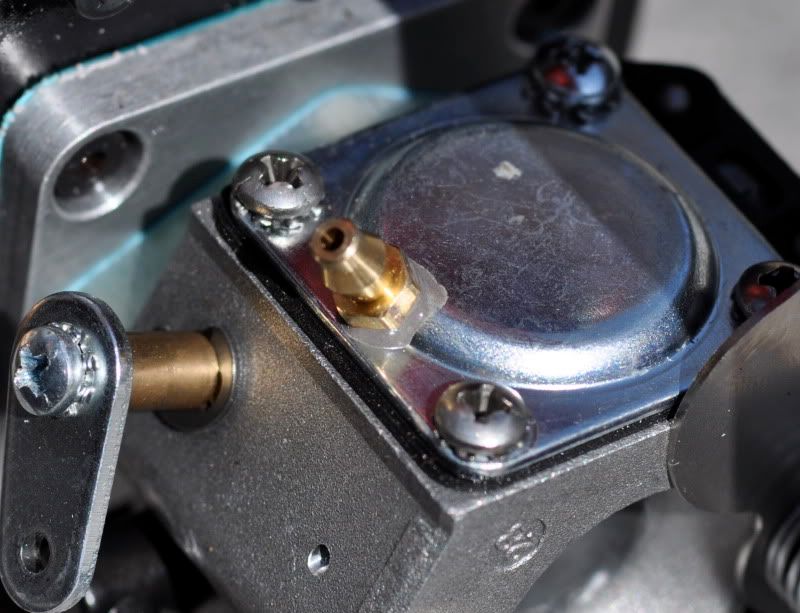
The OS GT-55 included a nipple in the diaphragm cover, to run a line into a dead air zone. On my Syssa, I modified the cover with a nipple and ran a line into the fuse where the hose goes into a plastic prescription bottle or a plastic film can.
<br type="_moz" />
<br type="_moz" />
05-01-2010 | 07:16 AM
#7
Senior Member
RE: Carb location?
I have tried all kind of things, including the tube to the carb mouth. Latter can be made to work, but is quite engine specific. Location and angle of tube ending in the carb mouth are critical, because airflow affects regulating pressure (sometimes to advantage).
I still found the static tube approach the best overall solution, with the static tube located outside the plane fuselage in straight airflow regions.
I still found the static tube approach the best overall solution, with the static tube located outside the plane fuselage in straight airflow regions.
05-01-2010 | 07:26 AM
#8
Senior Member
My Feedback: (3)
Joined: Sep 2009
Posts: 1,300
Likes: 0
Received 0 Likes
on
0 Posts
From: Bedford,
NH
RE: Carb location?
It definitely seems that there is an business opportunity here for an EFI system. These engines and the chain saw are the only carbs I have, even my John Deere tractor is fuel injected.
05-01-2010 | 09:57 AM
#9
Senior Member
My Feedback: (1)
RE: Carb location?
ORIGINAL: Antique
And I found turning the 3W venturi so air is forced in got 200 more rpm....On my test stand...Twin cylinder pusher drone engines have the carbs facing forward..there's a tube in the venturi at a 45 degree angle that leads to the cover over the metering diaphragm..No other holes in the cover...Works very well in that application....
And I found turning the 3W venturi so air is forced in got 200 more rpm....On my test stand...Twin cylinder pusher drone engines have the carbs facing forward..there's a tube in the venturi at a 45 degree angle that leads to the cover over the metering diaphragm..No other holes in the cover...Works very well in that application....
Experimented with rotating the 3w snorkel on aft mounted 106's used with "drones" in 2005 and had the same results. Instant rpm boost.
EFI has already been done on our size engines, used for long duration applications. You can't afford them. Re-phrase that, maybe one gas engine buyer in 5,000 might consider it but would not justify the increase in engine cost. Try adding over $2,000.00 to the cost of any engine so equipped. People don't like paying more that $300.00 to $700.00 for engines between 26 and 112cc's so they would scream bloody murder when they came up against the cost of an injected engine. Those making them have no reason to lower the price below production costs and are not letting the design technology out of house. I can't fault them at all.
05-01-2010 | 02:06 PM
#10
Thread Starter
My Feedback: (2)
Joined: Jan 2003
Posts: 737
Likes: 0
Received 0 Likes
on
0 Posts
From: Billingsley, AL
RE: Carb location?
Is the rpm boost linear across the rpm range? Or does it vary with the rpm. Antique has said that air can't be forced into the venturi of a Walbro carb. Is that because the venturi velocity is faster than the prop blast? I'm not trying to argue with anyone. Just asking some questions that I've had. Another is "Does a surface unload when the airframe begins to move away from airstream". As in an aileron starting to rotate the wing. Does the load on the servo decrease or does the forward motion keep the load mostly constant?
05-01-2010 | 02:20 PM
#11
Senior Member
My Feedback: (3)
Joined: Sep 2009
Posts: 1,300
Likes: 0
Received 0 Likes
on
0 Posts
From: Bedford,
NH
RE: Carb location?
Good point, and in any case, the in-tank pump, mass airflow sensor, throttle position sensor, pressure sensor, rpm sensor, et all, would inevitably add weight and electrical power consumption over a Walbro.
05-01-2010 | 02:39 PM
#13
Senior Member
My Feedback: (1)
RE: Carb location?
On a proportional level, quite a bit. However the complexity is increased exponentially, and the electrical load has to be carefully planned and provided for.
For ec121,
The effects of the reversed 3w snorkel needs to be catagorized a little better. Most drones are "pusher" configurations, with the propeller aft of the carb. Turning the snorkel around is not influenced by the propeller really, un less one wants to factor the possibility of a low pressure area between the prop and the carb. In this cae we're dealing mostly with ram air effects. The increase in rpm may or may not be linear because they are generally notable at peak rpm levels with the aircraft in flight. You would need to first note the baseline performance of the engine on a dyno and verify the fuel map before turning the snorkel. Then turn the snorkel and check all the standard parameters once again to see the effects of increased air velocities at various airspeeds. Nothing really changes at zero airspeed, only with the aircraft in motion. Again, the propeller does not have a significant influence in this instance.
For ec121,
The effects of the reversed 3w snorkel needs to be catagorized a little better. Most drones are "pusher" configurations, with the propeller aft of the carb. Turning the snorkel around is not influenced by the propeller really, un less one wants to factor the possibility of a low pressure area between the prop and the carb. In this cae we're dealing mostly with ram air effects. The increase in rpm may or may not be linear because they are generally notable at peak rpm levels with the aircraft in flight. You would need to first note the baseline performance of the engine on a dyno and verify the fuel map before turning the snorkel. Then turn the snorkel and check all the standard parameters once again to see the effects of increased air velocities at various airspeeds. Nothing really changes at zero airspeed, only with the aircraft in motion. Again, the propeller does not have a significant influence in this instance.
05-01-2010 | 04:44 PM
#14
Senior Member
RE: Carb location?
Hmmm... Seems like clutching at straws for those who would do anything forthe slightest speed boost, just like polishing ports, rods and crankshafts. I suppose more gain is to be had with a slight change in port shapes and timing? Or even a better muffler.
05-01-2010 | 05:12 PM
#15
Senior Member
My Feedback: (1)
RE: Carb location?
Agreed Pe. Polishing ports is something fun to do when you are bored and have little else on your plate. It's largest benefit is providing a short break from other drudgery.
The average modeler seeking better performance would obtain much easier, and quite pronounced gains, by alterations in ignitiontiming at high rpm and improved port design/timing. Most cylinders use ports originally developed for chain saws and lawn mowers. Not even close to ideal for our purposes. But you already know that. The port design and layout in the MVVS engine line is far superior to most anything else on the market. So good that one manufacturer has already tried to copy it.
Lest we forget, many would experience better performance through simple engine tuning and doing some prop experimentation instead of relying on reports from others about what prop works best. The highest rpm does not always equate to the best performance...
The average modeler seeking better performance would obtain much easier, and quite pronounced gains, by alterations in ignitiontiming at high rpm and improved port design/timing. Most cylinders use ports originally developed for chain saws and lawn mowers. Not even close to ideal for our purposes. But you already know that. The port design and layout in the MVVS engine line is far superior to most anything else on the market. So good that one manufacturer has already tried to copy it.
Lest we forget, many would experience better performance through simple engine tuning and doing some prop experimentation instead of relying on reports from others about what prop works best. The highest rpm does not always equate to the best performance...
05-01-2010 | 05:55 PM
#16

Joined: Oct 2003
Posts: 1,270
Likes: 0
Received 0 Likes
on
0 Posts
From: , MA
RE: Carb location?
This MVVS 26cc with its Walbro carb sitting up front in the breeze never exhibited any mixture ill effects in the installations shown in the pictures below. One of the planes is a Sig CAP 213EX and the other is an Ultra-RC Giles 202. Are there any opinions as to why it is immune? Is the problem engine specific or did I just get lucky with these two installations?
05-02-2010 | 08:44 AM
#19
Thread Starter
My Feedback: (2)
Joined: Jan 2003
Posts: 737
Likes: 0
Received 0 Likes
on
0 Posts
From: Billingsley, AL
RE: Carb location?
Both installations have the balance hole away from the direct impingement of the airstream. As long as the airflow through the cowl isn't turbulent, you may not need to worry about it. I am


