


Electronic solutions to modifying glow engines of all sizes to gasoline
 08-24-2022 | 12:04 PM
#526

 08-24-2022 | 12:41 PM
#528
08-24-2022 | 12:52 PM
#529


Not the 125, it uses the same cam as the 50 thru 115. The 120, 150 & 180 big block Saitos use a different cam,
The 200ti has the 24/48 spur gear configuration.
A wouldn't ask the time of day from the previous owner. Lots of things he did to this engine shows his carelessness.
Clarence Lee cam specs (claims front and rear are identical)
Intake opens at 40 btdc, closes at 60 abdc
Exhaust opens at 75 bbdc, closes at 25 atdc
The front cam I installed (May not be right correct one)
Intake opens at 24 btdc, closes at 58 abdc
Exhaust opens at 68 bbdc, closes 24 atdc
As you can see, My cam does have a significantly wider LSA.
The cam that was in the rear has an even wider LSA.
The 200ti has the 24/48 spur gear configuration.
A wouldn't ask the time of day from the previous owner. Lots of things he did to this engine shows his carelessness.
Clarence Lee cam specs (claims front and rear are identical)
Intake opens at 40 btdc, closes at 60 abdc
Exhaust opens at 75 bbdc, closes at 25 atdc
The front cam I installed (May not be right correct one)
Intake opens at 24 btdc, closes at 58 abdc
Exhaust opens at 68 bbdc, closes 24 atdc
As you can see, My cam does have a significantly wider LSA.
The cam that was in the rear has an even wider LSA.
Maybe why the original owner got rid of it... Run it and see how it runs... I know the cam valve timing will not be identical between the two cylinder for performance reasons... they must have changed the cam profile after it went into production from the prototype Clarence reviewed.
From horizon
$43 for the front cam
$32 for the rear cam
08-24-2022 | 12:54 PM
#530

Are the two cylinders supposed to have different valve dwell times?
Not the 125, it uses the same cam as the 50 thru 115. The 120, 150 & 180 big block Saitos use a different cam,
The 200ti has the 24/48 spur gear configuration.
A wouldn't ask the time of day from the previous owner. Lots of things he did to this engine shows his carelessness.
Clarence Lee cam specs (claims front and rear are identical)
Intake opens at 40 btdc, closes at 60 abdc
Exhaust opens at 75 bbdc, closes at 25 atdc
The front cam I installed (May not be right correct one)
Intake opens at 24 btdc, closes at 58 abdc
Exhaust opens at 68 bbdc, closes 24 atdc
As you can see, My cam does have a significantly wider LSA.
The cam that was in the rear has an even wider LSA.
The 200ti has the 24/48 spur gear configuration.
A wouldn't ask the time of day from the previous owner. Lots of things he did to this engine shows his carelessness.
Clarence Lee cam specs (claims front and rear are identical)
Intake opens at 40 btdc, closes at 60 abdc
Exhaust opens at 75 bbdc, closes at 25 atdc
The front cam I installed (May not be right correct one)
Intake opens at 24 btdc, closes at 58 abdc
Exhaust opens at 68 bbdc, closes 24 atdc
As you can see, My cam does have a significantly wider LSA.
The cam that was in the rear has an even wider LSA.
08-24-2022 | 12:55 PM
#531
08-24-2022 | 01:03 PM
#532
The valve opening duration may be different between cylinders, not sure, haven't measured it. The lobe separation angles do have to be different between cylinders on twins however. I'm not 100% sure why but have heard it's because the cams spin opposite directions and the intake and exhaust ports are on opposite sides. Still makes no sense to me explained that way. But then, I can be about as sharp as a basketball at times.
08-24-2022 | 03:07 PM
#533
Thats part of the reason, and why the cams can't be interchanged, if they could they would have the same part#... exhaust valves open early before bdc on the power stroke to blow down the cylinder combustion pressure before the piston starts the exhaust upstroke... thats done so the piston doesn't start to re-compress the expanding exhaust gases, which rob power from the next cylinder's combustion / power stroke., valve duration effects overlap and exhaust reversion / and induction standoff.... saito's known for their aggressive cam profiles, they mimic RW engine performance profiles why I was surprised the prototype shared the same valve timing for both cylinders
.
I only owned 4 saito's,. a .50GK, 1.30TD, 1.50s, and 1.80 NIB.... gave the 1.50s to a flying buddy, and sold the 1.80, I never had plans to used it, as I like the larger giant scale aircraft... I dislike the AAC's so I stopped purchasing saito... and they continue to disappoint with the 100TS having composite cam lobes.... otherwise they're nice performing engines.
.
I only owned 4 saito's,. a .50GK, 1.30TD, 1.50s, and 1.80 NIB.... gave the 1.50s to a flying buddy, and sold the 1.80, I never had plans to used it, as I like the larger giant scale aircraft... I dislike the AAC's so I stopped purchasing saito... and they continue to disappoint with the 100TS having composite cam lobes.... otherwise they're nice performing engines.
Last edited by John_M_; 08-24-2022 at 03:15 PM.
08-25-2022 | 02:59 AM
#534
Comparisons of even firing twins (Flat Twins vs In line Twins)
Thats part of the reason, and why the cams can't be interchanged, if they could they would have the same part#... exhaust valves open early before bdc on the power stroke to blow down the cylinder combustion pressure before the piston starts the exhaust upstroke... thats done so the piston doesn't start to re-compress the expanding exhaust gases, which rob power from the next cylinder's combustion / power stroke., valve duration effects overlap and exhaust reversion / and induction standoff.... saito's known for their aggressive cam profiles, they mimic RW engine performance profiles why I was surprised the prototype shared the same valve timing for both cylinders
.
I only owned 4 saito's,. a .50GK, 1.30TD, 1.50s, and 1.80 NIB.... gave the 1.50s to a flying buddy, and sold the 1.80, I never had plans to used it, as I like the larger giant scale aircraft... I dislike the AAC's so I stopped purchasing saito... and they continue to disappoint with the 100TS having composite cam lobes.... otherwise they're nice performing engines.
.
I only owned 4 saito's,. a .50GK, 1.30TD, 1.50s, and 1.80 NIB.... gave the 1.50s to a flying buddy, and sold the 1.80, I never had plans to used it, as I like the larger giant scale aircraft... I dislike the AAC's so I stopped purchasing saito... and they continue to disappoint with the 100TS having composite cam lobes.... otherwise they're nice performing engines.
Having a closer look at the 2 two cams yesterday it appears I was wrong, the lobe separation is the same, so close I can't see a difference without measuring. The cams do have different part numbers, true, but it may be only because the timing marks on the gears are in different places?
So, thinking on this further there is a difference between an even fire flat twin and this even fire IL twin.
On an even fire flat twin the right cylinder configuration is identical to a single cylinder engine i.e. the cam is turning the same direction and the ports are on the same side. The left cylinder has the cam turning the same direction but the ports are reversed. That's what dictates the need for two different cams, each having different lobe separation angles. That's what I'm hearing anyway. So:
The front cylinder of the even firing 200 IL twin is configured just as the left cylinder of a even firing flat twin i.e. cam rotating same direction as a single but with ports reversed. The rear cylinder (when viewed from the rear of the engine) has the ports on the same side as a single HOWEVER, the cam is rotating backwards. This where things get confusing to me. Wouldn't the front and rear cylinders then use the same cam but get timed differently? The two cams I have appear to be just that, same cam profile but with different cam timing mark locations.
Sorry about the way I write, I'm not the best at communicating my thoughts.
The following users liked this post:
mk13 (09-18-2024)
08-25-2022 | 06:46 AM
#535
The valve opening closing would be similar... If thats all the differences between the two cams is just the timing mark, then its unusually for the $10 price difference between the two... the 200Ti front cam is from the left side cam of the odd fire 182 twin, that cylinder's valve timing / cam profile is the same as a single cylinder... the 200Ti rear cam could very well be just the timing mark reference index, but I believe there is a difference in valve opening closing timing by a few degrees between the two cylinders... Degree the front valve timing with the cam set on its timing mark in reference to TDC, and then rotate the crank counterclockwise 360 degrees (prop rotation) and see if you can dial in (degree) the rear cam valve open closing in degrees and disregard the cam timing mark, if you can't then the cam profile, valve opening closing, duration and overlap will be different between the two cylinders.
08-25-2022 | 08:13 AM
#536
The valve opening closing would be similar... If thats all the differences between the two cams is just the timing mark, then its unusually for the $10 price difference between the two... the 200Ti front cam is from the left side cam of the odd fire 182 twin, that cylinder's valve timing / cam profile is the same as a single cylinder... the 200Ti rear cam could very well be just the timing mark reference index, but I believe there is a difference in valve opening closing timing by a few degrees between the two cylinders... Degree the front valve timing with the cam set on its timing mark in reference to TDC, and then rotate the crank counterclockwise 360 degrees (prop rotation) and see if you can dial in (degree) the rear cam valve open closing in degrees and disregard the cam timing mark, if you can't then the cam profile, valve opening closing, duration and overlap will be different between the two cylinders.
I installed the 200ti rear cam into the front cylinder using the cam indexing hole, just in case the previous owner swapped them. The crank angle was 180° off.
Just for curiosity sake, I will degree both cams again, this time using a more accurate "final word" indicator (.0001"). The .001" indicator I used for previously measurements is not accurate enough to detect "a few degrees" difference in crank rotation.
08-25-2022 | 08:52 AM
#537
ugly plumbing
Completed mounting the engine and hooked up the cooling lines.
Got a 12v (fuel) pump and am wondering if that could help avoid overheating the engine?
There is about 2c between the screw and that pick up tube that is suposed to provide pressure for the cooling system.
Also hooked up a fuel tank with muffler pressure.

boat bowels
Got a 12v (fuel) pump and am wondering if that could help avoid overheating the engine?
There is about 2c between the screw and that pick up tube that is suposed to provide pressure for the cooling system.
Also hooked up a fuel tank with muffler pressure.
boat bowels
08-25-2022 | 09:07 AM
#539
starting
It goes into the groove on the flywheel and around a groove on the starter cone of a electric starter on the other side.
Then you are supposed to hold the starter up and press the boat down to get enough belt tension so it does not slip.
Once the engine is running tuck it away from moving parts like under the engine.
Older generations helicopters like the shuttle also where started with a belt.
Then you are supposed to hold the starter up and press the boat down to get enough belt tension so it does not slip.
Once the engine is running tuck it away from moving parts like under the engine.
Older generations helicopters like the shuttle also where started with a belt.
 08-25-2022 | 12:00 PM
#541
I have the cams timed correctly in the 200ti, I think. The "dot" index mark on the front cam facing straight down, the "dash" index mark on the rear cam facing straight down. The dot and dash index marks are 90° cam rotation apart, 180° crank rotation. Seemed logical, so I went with it.
The valve train movement is very close to what I would expect to see, however the rockers are not level with one another at TDC of the exhaust stroke. They are close but not perfectly level. It would take 1/2 of a tooth of cam rotation to make it them level, which of course is not possible. Bottom line, I would run it like it is.
Everything is set up to measure the opening and closing events later this afternoon.
Edit coming:
The valve train movement is very close to what I would expect to see, however the rockers are not level with one another at TDC of the exhaust stroke. They are close but not perfectly level. It would take 1/2 of a tooth of cam rotation to make it them level, which of course is not possible. Bottom line, I would run it like it is.
Everything is set up to measure the opening and closing events later this afternoon.
Edit coming:
Last edited by Glowgeek; 08-25-2022 at 12:16 PM.
08-25-2022 | 12:28 PM
#542
all new for me too
This came with a batch of rc things that included a almost complete raptor30 heli kit (reason i bought it) a crashed ego30 heli (stripped it down for engine and servos) and a unbuild multiplex "smiley"
It was "stored" in a damp (leaking?) shed for years and if i would not have bought it, it likely would have been trown out.
The picture below was one of 2 of the ad and that was all the info avaiable.
Had to do a lot of cleaning just to be able to handle it without getting dirty hands.
Never had a boat before (not really my thing). Getting these old things (about 25 years if not more) working again is a fun project and saves them from being wasted for now.
Btw have no idea what models those fuses belong to there are no wings or even drawings.

random rc stuff
It was "stored" in a damp (leaking?) shed for years and if i would not have bought it, it likely would have been trown out.
The picture below was one of 2 of the ad and that was all the info avaiable.
Had to do a lot of cleaning just to be able to handle it without getting dirty hands.
Never had a boat before (not really my thing). Getting these old things (about 25 years if not more) working again is a fun project and saves them from being wasted for now.
Btw have no idea what models those fuses belong to there are no wings or even drawings.
random rc stuff
08-25-2022 | 12:59 PM
#543
Completed mounting the engine and hooked up the cooling lines.
Got a 12v (fuel) pump and am wondering if that could help avoid overheating the engine?
There is about 2c between the screw and that pick up tube that is suposed to provide pressure for the cooling system.
Also hooked up a fuel tank with muffler pressure.
boat bowels
Got a 12v (fuel) pump and am wondering if that could help avoid overheating the engine?
There is about 2c between the screw and that pick up tube that is suposed to provide pressure for the cooling system.
Also hooked up a fuel tank with muffler pressure.
boat bowels
No worries, it WILL cool.
08-25-2022 | 02:10 PM
#544
Saito FA200ti valve event timing
I feel the measurements are within +/- 1°. Results are averaged from 4 measurements using a degree wheel, piston stop and final word indicator. Measurements were repeatable within 1 degree.
Front/Left Cylinder:
Intake opens at 46 btdc, closes at 55 abdc
Exhaust opens at 78 bbdc, closes at 25 atdc
Rear/Right Cylinder
Intake opens at 48 btdc, closes at 55 abdc
Exhaust opens at 75 bbdc, closes at 28 atdc
Clarence Lee measurements:
Front and Rear Cylinders:
Intake opens at 40 btdc, closes at 60 abdc
Exhaust opens at 75 bbdc, closes at 25 atdc
She's ready to run when I receive the inserts from Chris.
Many thanks to all that helped!
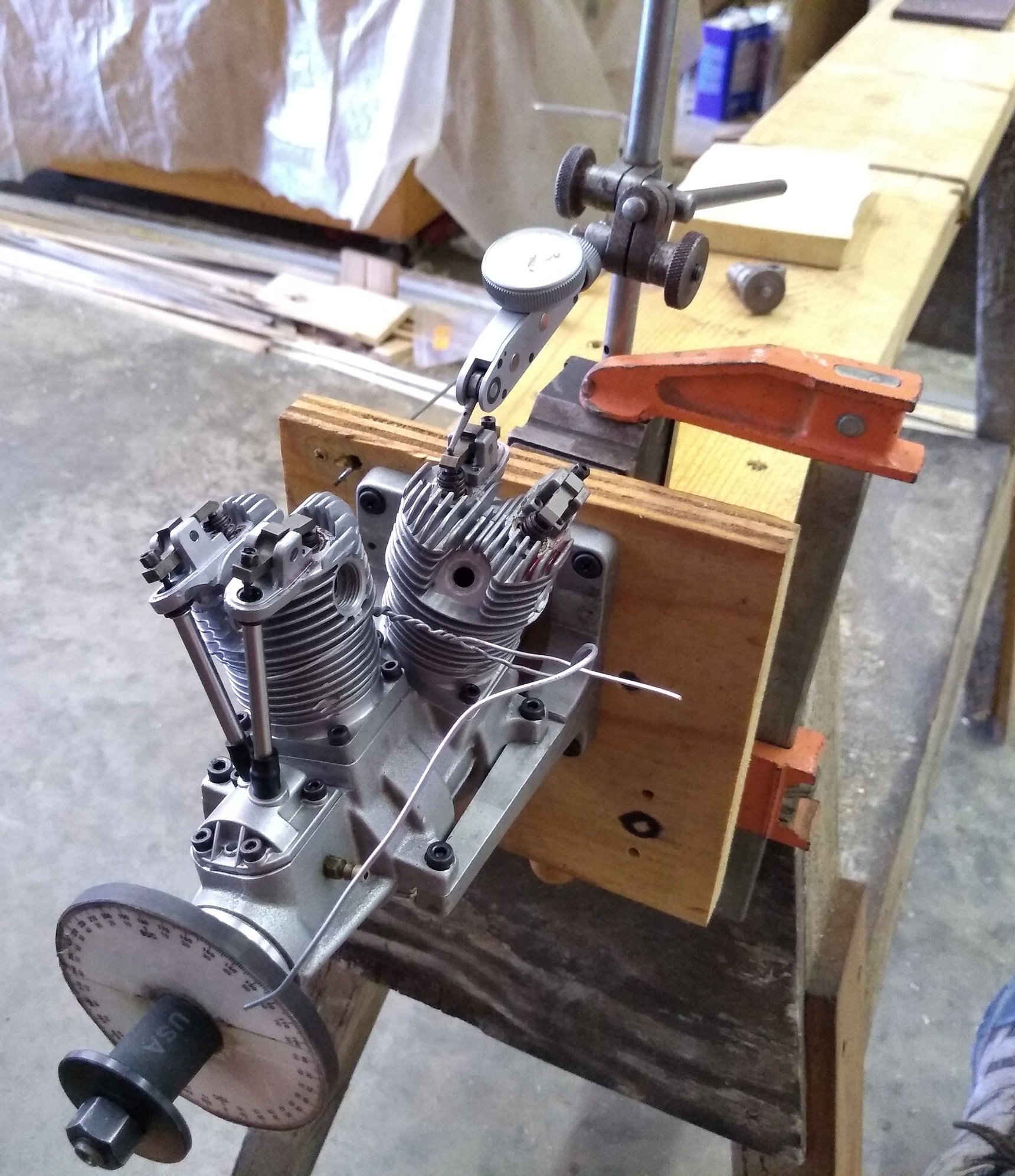
Front/Left Cylinder:
Intake opens at 46 btdc, closes at 55 abdc
Exhaust opens at 78 bbdc, closes at 25 atdc
Rear/Right Cylinder
Intake opens at 48 btdc, closes at 55 abdc
Exhaust opens at 75 bbdc, closes at 28 atdc
Clarence Lee measurements:
Front and Rear Cylinders:
Intake opens at 40 btdc, closes at 60 abdc
Exhaust opens at 75 bbdc, closes at 25 atdc
She's ready to run when I receive the inserts from Chris.
Many thanks to all that helped!
08-25-2022 | 09:26 PM
#545
Thats what I expected, the intake valve opens later on the rear cylinder... works in a similar way to exhaust blow down, but instead improves the induction velocity / cylinder fill... the rear cylinder is the stronger of the two,... the front cylinder absorbs a bit more power, but the two cylinders balance out across the 720 degree engine cycle.
The front cylinder is the right hand cylinder ( starboard side )... and the rear cylinder is the left hand cylinder ( port side ) when viewed from sitting in the cockpit... that's how its described in the RCM Saito 4 stroke handbook for the saito twin cylinder engines...it has some useful information, but unfortunately that book was published before the inline twins were released... I did see someone uploaded a scanned copy in pdf format, but I don't recall where it was posted... it only really matters to the person standing in front or from behind, as long as you have the cylinder parts relationship understood, thats all that really matters.
The front cylinder is the right hand cylinder ( starboard side )... and the rear cylinder is the left hand cylinder ( port side ) when viewed from sitting in the cockpit... that's how its described in the RCM Saito 4 stroke handbook for the saito twin cylinder engines...it has some useful information, but unfortunately that book was published before the inline twins were released... I did see someone uploaded a scanned copy in pdf format, but I don't recall where it was posted... it only really matters to the person standing in front or from behind, as long as you have the cylinder parts relationship understood, thats all that really matters.Last edited by John_M_; 08-25-2022 at 09:41 PM. Reason: Cylinder releationship
08-26-2022 | 04:09 AM
#546
the valve dwell times are similar for both cylinders now too.
I feel the measurements are within +/- 1°. Results are averaged from 4 measurements using a degree wheel, piston stop and final word indicator. Measurements were repeatable within 1 degree.
Front/Left Cylinder:
Intake opens at 46 btdc, closes at 55 abdc
Exhaust opens at 78 bbdc, closes at 25 atdc
Rear/Right Cylinder
Intake opens at 48 btdc, closes at 55 abdc
Exhaust opens at 75 bbdc, closes at 28 atdc
Clarence Lee measurements:
Front and Rear Cylinders:
Intake opens at 40 btdc, closes at 60 abdc
Exhaust opens at 75 bbdc, closes at 25 atdc
She's ready to run when I receive the inserts from Chris.
Many thanks to all that helped!
Front/Left Cylinder:
Intake opens at 46 btdc, closes at 55 abdc
Exhaust opens at 78 bbdc, closes at 25 atdc
Rear/Right Cylinder
Intake opens at 48 btdc, closes at 55 abdc
Exhaust opens at 75 bbdc, closes at 28 atdc
Clarence Lee measurements:
Front and Rear Cylinders:
Intake opens at 40 btdc, closes at 60 abdc
Exhaust opens at 75 bbdc, closes at 25 atdc
She's ready to run when I receive the inserts from Chris.
Many thanks to all that helped!
08-26-2022 | 04:18 AM
#547
Thats what I expected, the intake valve opens later on the rear cylinder... works in a similar way to exhaust blow down, but instead improves the induction velocity / cylinder fill... the rear cylinder is the stronger of the two,... the front cylinder absorbs a bit more power, but the two cylinders balance out across the 720 degree engine cycle.
The front cylinder is the right hand cylinder ( starboard side )... and the rear cylinder is the left hand cylinder ( port side ) when viewed from sitting in the cockpit... that's how its described in the RCM Saito 4 stroke handbook for the saito twin cylinder engines...it has some useful information, but unfortunately that book was published before the inline twins were released... I did see someone uploaded a scanned copy in pdf format, but I don't recall where it was posted... it only really matters to the person standing in front or from behind, as long as you have the cylinder parts relationship understood, thats all that really matters.
The front cylinder is the right hand cylinder ( starboard side )... and the rear cylinder is the left hand cylinder ( port side ) when viewed from sitting in the cockpit... that's how its described in the RCM Saito 4 stroke handbook for the saito twin cylinder engines...it has some useful information, but unfortunately that book was published before the inline twins were released... I did see someone uploaded a scanned copy in pdf format, but I don't recall where it was posted... it only really matters to the person standing in front or from behind, as long as you have the cylinder parts relationship understood, thats all that really matters. That threw me at first too.
I would agree that the cam profiles could be slightly different, however this is a preowned engine with different wear patterns on each tappet. One of them is worn into a domed shape and two of them have flat spots at the edges.
As it is, the opening and closing events are measured from just off the base circle of the lobe, so irregularly worn tappets could easily account for a few degrees of crank angle variance when measuring. The only way to be 100% sure is to measure using new parts and zero valve lash.
Last edited by Glowgeek; 08-26-2022 at 08:12 AM.

 08-26-2022 | 08:38 AM
#550
 engine only runs off its prime
Some succes and the next problem.
Was able to get the engine to fire but it only runs a short while off it prime.
It does not draw fuel unless i put a finger over the air intake.
In all am verry happy with the result; it tried to escape the tub twice so there is life in the bugger.
No video it where just short burst so no time to start recording
Was able to get the engine to fire but it only runs a short while off it prime.
It does not draw fuel unless i put a finger over the air intake.
In all am verry happy with the result; it tried to escape the tub twice so there is life in the bugger.
No video it where just short burst so no time to start recording

