


Electronic solutions to modifying glow engines of all sizes to gasoline
 11-02-2022 | 07:43 PM
#1101


My Feedback: (1)

The white stuff showed up here today - Got to November this year, but looks like the permanent stuff has arrived. A little more shop play time now hiding out from the cold.


 11-04-2022 | 08:38 AM
#1104
Untill then, this has to make do. There are no "pusher" mufflers availlable for this engine, and the only other possibility is pointing it upwards because rotating it 180 degrees it interferes with the propdisc. And vertical makes it look like the smokestack of a steamroller...

As long as the plane is flying, it remains completely oilfree in this configuration, and the engine seemed not to mind when it was running in the tunnel (where airvelocity is near equal to pitchspeed.
11-05-2022 | 05:49 AM
#1107
Well... the first attempt at a maiden failed due to a combination of freshly mown grass (lots of clippings) and too wet, making those clippings sticky.
What happened is that the grass collected in the swingarm of the nose gear, not only braking the wheel but also compressing the suspension. So the plane did 2 things: not gather much speed, AND the AoA (which on the ground is 3,5 degrees) reduced to about zero...
I need either a dry field or a paved runway.
On the upside: the plane tracks straight on the ground without even the slightest tendency to break either left or right, as long as the nose gear is not fully compressed, the suspension makes for a very smooth ride, and apparently the modifications I made to the airflow towards the engine made for good cooling, because the engine never overheated during the take off attempts and also not during the downwind return rides. It never came abouve 125 degC core temperature.
The engine also appears to handle well and fairly reliable.
Pretty happy about that, less happy about the grass issue...
What happened is that the grass collected in the swingarm of the nose gear, not only braking the wheel but also compressing the suspension. So the plane did 2 things: not gather much speed, AND the AoA (which on the ground is 3,5 degrees) reduced to about zero...
I need either a dry field or a paved runway.
On the upside: the plane tracks straight on the ground without even the slightest tendency to break either left or right, as long as the nose gear is not fully compressed, the suspension makes for a very smooth ride, and apparently the modifications I made to the airflow towards the engine made for good cooling, because the engine never overheated during the take off attempts and also not during the downwind return rides. It never came abouve 125 degC core temperature.
The engine also appears to handle well and fairly reliable.
Pretty happy about that, less happy about the grass issue...
The following users liked this post:
1967brutus (11-05-2022)
11-05-2022 | 06:11 AM
#1109
My Feedback: (1)
Its so close to going Bert... You could give it more nose up in the ground stance but that could make for a tricky takeoff even if it went off the grass as you would be leaving with lots of up elevator in a high drag condition. Better to find a field that offers less "resistance". It looks to have plenty of power for a delta and once it breaks ground I think you will have a winner. I love deltas and have flown quite a few. They are odd as they are a very efficient planform once "on the step" but sometimes its tricky to get them there. I have done a few models of the Iconic Canadian Avro Arrow. Most flew around at very low power settings once airborne but took a good push to get them going. Also be careful getting them too slow and getting the nose up as they can become unpredictable and hard to get "on the step" again. Your design, like a jet, lacks the low speed flow over the controls.
11-05-2022 | 06:44 AM
#1111
Its so close to going Bert... You could give it more nose up in the ground stance but that could make for a tricky takeoff even if it went off the grass as you would be leaving with lots of up elevator in a high drag condition. Better to find a field that offers less "resistance". It looks to have plenty of power for a delta and once it breaks ground I think you will have a winner. I love deltas and have flown quite a few. They are odd as they are a very efficient planform once "on the step" but sometimes its tricky to get them there. I have done a few models of the Iconic Canadian Avro Arrow. Most flew around at very low power settings once airborne but took a good push to get them going. Also be careful getting them too slow and getting the nose up as they can become unpredictable and hard to get "on the step" again. Your design, like a jet, lacks the low speed flow over the controls.
What happened is that huge lumps of wet grass clippings collected here:
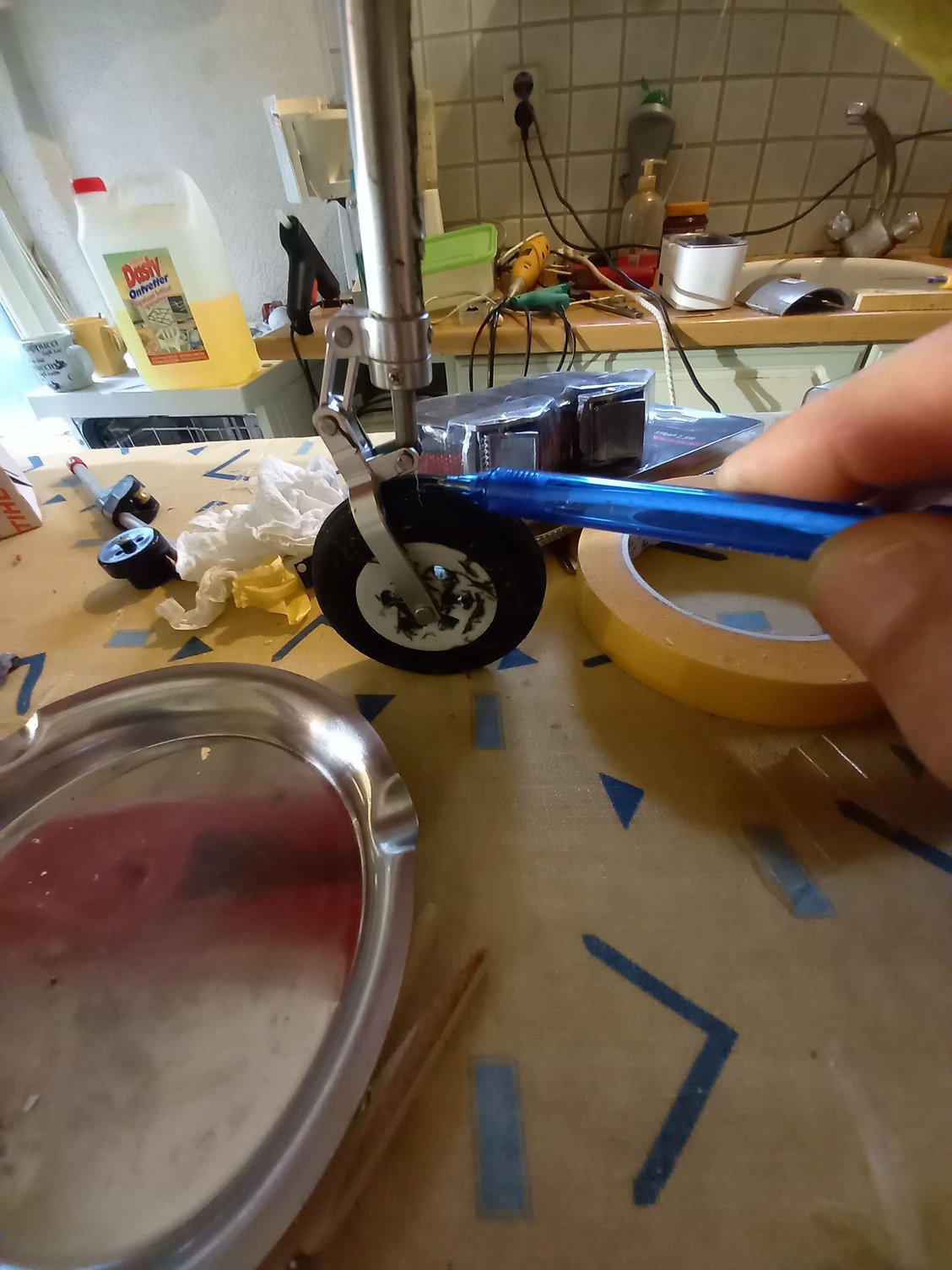
Where I am pointing with the pen. That grass wedges itself between the wheel and the swingarm cantilever.
That causes a torque on the swingarm such that the spring compresses. A bit comparable with what shaft drive does on older motorcycles: Engine braking compresses the suspension there too.
If you watch the vid, a few seconds into the take-off rns you will suddenly see the nose bouncing. The field is not particularly bumpy there or anywhere else, so that is where the nose wheel bottoms out due to this grass collecting. By that time the stance has changed from 3,5 degrees to -0,9 degrees, and the thing sucks itself to the ground.
Without those clippings, OR when the field is dry, I am convinced it won't do that, maintain its stance and just take off. I was seeing about 15 m/s, and at this weight (2300) and wing area (about 46 square dm) that should fly. It does not even get light, so that's the nose dipping.
Last edited by 1967brutus; 11-05-2022 at 11:40 AM.
11-05-2022 | 06:13 PM
#1112
My Feedback: (1)
Hey Bert, Will trade you wet grass clipping for this mess... Mother Nature has unleashed a Classic Saskatchewan Blizzard on us to kick off winter here lots of snow and wind and drifts are building!!!
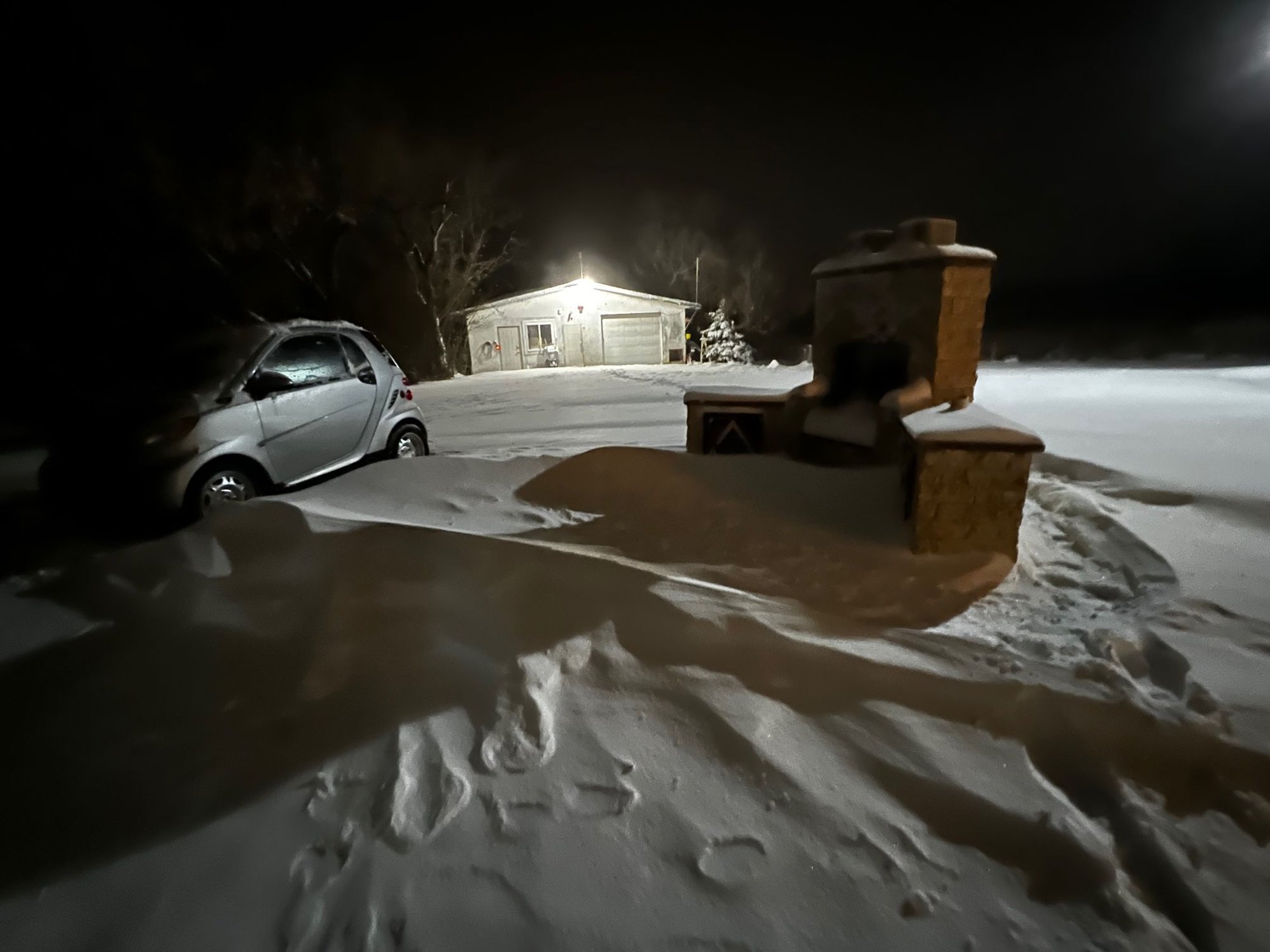
SO.... I'll hide in the shop and Play !!!
Did a bit more work on the e-pressure control - I have re-done the code to allow for a RC channel input to drive a curve - Just like the solenoid controller, while still having the underlying RPM driven pressure curve. What this means is that the engine rpm will drive the main curve but it can be manipulated on a curve mix just like the pressure controller. The RPM curve is the master though and will always increase as engine speed increases (on an exponential curve that's settable) Im hoping to test it out on the OS .37SZ just on the stock carb... If this works it would be a very simple install. Here is a video that might show it better.
SO.... I'll hide in the shop and Play !!!
Did a bit more work on the e-pressure control - I have re-done the code to allow for a RC channel input to drive a curve - Just like the solenoid controller, while still having the underlying RPM driven pressure curve. What this means is that the engine rpm will drive the main curve but it can be manipulated on a curve mix just like the pressure controller. The RPM curve is the master though and will always increase as engine speed increases (on an exponential curve that's settable) Im hoping to test it out on the OS .37SZ just on the stock carb... If this works it would be a very simple install. Here is a video that might show it better.
11-06-2022 | 12:19 AM
#1113
Dang, Chris, that's beautiful but uncomfortable, the snow I mean.
As for the pressure control, I have to absolutely admit that those compounded curves are a bit outside my grasp at the moment. I hope you get it working though!
As for the pressure control, I have to absolutely admit that those compounded curves are a bit outside my grasp at the moment. I hope you get it working though!
Last edited by 1967brutus; 11-06-2022 at 02:02 AM.
11-06-2022 | 04:37 AM
#1114
If that second curve works we should strongly consider moving to an s.bus or some other sort of composite channel input to keep the wiring simple. It would also pave the way for additional control settings via other rc channels since we could read as many channels as we want.
Pretty much all of the frsky receivers have s.bus outputs. Is s.bus readily available on your multiplex receivers too, Chris?
Pretty much all of the frsky receivers have s.bus outputs. Is s.bus readily available on your multiplex receivers too, Chris?
Hey Bert, Will trade you wet grass clipping for this mess... Mother Nature has unleashed a Classic Saskatchewan Blizzard on us to kick off winter here lots of snow and wind and drifts are building!!!
SO.... I'll hide in the shop and Play !!!
Did a bit more work on the e-pressure control - I have re-done the code to allow for a RC channel input to drive a curve - Just like the solenoid controller, while still having the underlying RPM driven pressure curve. What this means is that the engine rpm will drive the main curve but it can be manipulated on a curve mix just like the pressure controller. The RPM curve is the master though and will always increase as engine speed increases (on an exponential curve that's settable) Im hoping to test it out on the OS .37SZ just on the stock carb... If this works it would be a very simple install. Here is a video that might show it better.
https://www.youtube.com/watch?v=1Z_TWHC7Vao
SO.... I'll hide in the shop and Play !!!
Did a bit more work on the e-pressure control - I have re-done the code to allow for a RC channel input to drive a curve - Just like the solenoid controller, while still having the underlying RPM driven pressure curve. What this means is that the engine rpm will drive the main curve but it can be manipulated on a curve mix just like the pressure controller. The RPM curve is the master though and will always increase as engine speed increases (on an exponential curve that's settable) Im hoping to test it out on the OS .37SZ just on the stock carb... If this works it would be a very simple install. Here is a video that might show it better.
https://www.youtube.com/watch?v=1Z_TWHC7Vao
11-06-2022 | 06:21 AM
#1115
If I understand correctly, the first curve is fixed and simulates exponential muffler pressure with rpm. As with muffler pressure it will supply extra fuel with prop unloading in the air. The second programmable curve is for fine tuning from the TX, similar to our current curve using the solenoid.
11-06-2022 | 12:21 PM
#1116
My Feedback: (1)
Your correct Lonnie... Master curve is the RPM following one and is set in the script by Max RPM and an expo value (can curve the response based on this setting similar to expo on our radios). This strictly is more RPM=More fuel. Then a single input channel can bias the output of the first curve up or down based on a radio curve like our solenoid setups. The only other parameter is the bleed needle which is simply set to a "max pressure" at full pump speed (100% duty cycle).
Got the snow all cleared out today so hope to be able to get this closer to running on an engine to see it its viable or not.
Chris
Got the snow all cleared out today so hope to be able to get this closer to running on an engine to see it its viable or not.
Chris
11-06-2022 | 01:13 PM
#1117
Your correct Lonnie... Master curve is the RPM following one and is set in the script by Max RPM and an expo value (can curve the response based on this setting similar to expo on our radios). This strictly is more RPM=More fuel. Then a single input channel can bias the output of the first curve up or down based on a radio curve like our solenoid setups. The only other parameter is the bleed needle which is simply set to a "max pressure" at full pump speed (100% duty cycle).
Got the snow all cleared out today so hope to be able to get this closer to running on an engine to see it its viable or not.
Chris
Got the snow all cleared out today so hope to be able to get this closer to running on an engine to see it its viable or not.
Chris
With an airbleed or 2 needle carb setup I'm thinking you won't need more than 0.7 psi to allow things to work right. That may be a good thing, allowing the relief valve to be opened more, speeding the release of tank pressure on throttle down. Hypothesizing.
Last edited by Glowgeek; 11-06-2022 at 01:19 PM.
11-06-2022 | 03:57 PM
#1118
My Feedback: (1)
My initial thought going into this is a bit more than "normal" pressure (maybe 1 psi) and pinching a bit on the top end and idle settings - This should allow for a bit of headroom to lean out the typically rich mid range by backing off the pressure a bit more there.
All theory until we actually run it.. 
All theory until we actually run it..
11-10-2022 | 12:26 PM
#1119

Well... the first attempt at a maiden failed due to a combination of freshly mown grass (lots of clippings) and too wet, making those clippings sticky.
What happened is that the grass collected in the swingarm of the nose gear, not only braking the wheel but also compressing the suspension. So the plane did 2 things: not gather much speed, AND the AoA (which on the ground is 3,5 degrees) reduced to about zero...
I need either a dry field or a paved runway.
https://www.youtube.com/watch?v=YN7idEdeIjs
On the upside: the plane tracks straight on the ground without even the slightest tendency to break either left or right, as long as the nose gear is not fully compressed, the suspension makes for a very smooth ride, and apparently the modifications I made to the airflow towards the engine made for good cooling, because the engine never overheated during the take off attempts and also not during the downwind return rides. It never came abouve 125 degC core temperature.
The engine also appears to handle well and fairly reliable.
Pretty happy about that, less happy about the grass issue...
What happened is that the grass collected in the swingarm of the nose gear, not only braking the wheel but also compressing the suspension. So the plane did 2 things: not gather much speed, AND the AoA (which on the ground is 3,5 degrees) reduced to about zero...
I need either a dry field or a paved runway.
https://www.youtube.com/watch?v=YN7idEdeIjs
On the upside: the plane tracks straight on the ground without even the slightest tendency to break either left or right, as long as the nose gear is not fully compressed, the suspension makes for a very smooth ride, and apparently the modifications I made to the airflow towards the engine made for good cooling, because the engine never overheated during the take off attempts and also not during the downwind return rides. It never came abouve 125 degC core temperature.
The engine also appears to handle well and fairly reliable.
Pretty happy about that, less happy about the grass issue...
You need a run of short cut artificial turf, and stake it to the ground for a temporary rwy... There's a couple Brothers from Slovenia I believe, that use a run of heavy duty ground underlayment for their rwy, but for some reason the moles are attracted to it and burrow underneath it... probably the warmth and moisture generated by the cover ground attracts the grubs.
11-10-2022 | 12:50 PM
#1120
No doubt a paved runway would help with the legs "as is", but here's the nasty thing: that nose leg suspension ain't right.
The swingarm in extended position is near vertical, while the cantilever acting on the vertical spring is near horizontal.
Now when the plane rolls, due to this setup, the slightest bump will push the wheel backwards, compressing the spring.
This will bring the swingarm towards horizontal, but the cantilever towards vertical. This changes the springing geometry such, that the springforce is regressive instead of progressive. The further the suspension is compressed, the lower the returning force becomes.I tested this with weights, and at a given additional weight that will NOT compress the extended spring, when the nose is pushed down the spring will not return.
So when the plane rolls down the runway, the suspension compresses but won't come back.
For the maiden I improvised with a few tie-raps around the plunger, but that basically limited the spring travel "hard", which resulted in a bad landing.
So now I put a few O-rings around the spring plunger, that add a bump of additional springforce about halfway through the travel, and that should cure the issue.
![Click image for larger version
Name: 20221107_213427[1].jpg
Views: 789
Size: 152.1 KB
ID: 2272450](https://www.rcuniverse.com/forum/attachment.php?attachmentid=2272450&thumb=1&d=1668113491)
The swingarm in extended position is near vertical, while the cantilever acting on the vertical spring is near horizontal.
Now when the plane rolls, due to this setup, the slightest bump will push the wheel backwards, compressing the spring.
This will bring the swingarm towards horizontal, but the cantilever towards vertical. This changes the springing geometry such, that the springforce is regressive instead of progressive. The further the suspension is compressed, the lower the returning force becomes.I tested this with weights, and at a given additional weight that will NOT compress the extended spring, when the nose is pushed down the spring will not return.
So when the plane rolls down the runway, the suspension compresses but won't come back.
For the maiden I improvised with a few tie-raps around the plunger, but that basically limited the spring travel "hard", which resulted in a bad landing.
11-10-2022 | 06:11 PM
#1122
It MIGHT also indicate a slightly nose-heavy CoG, seeing that the plane was quite stable on the elevator axis.
11-10-2022 | 06:25 PM
#1123
No doubt a paved runway would help with the legs "as is", but here's the nasty thing: that nose leg suspension ain't right.
The swingarm in extended position is near vertical, while the cantilever acting on the vertical spring is near horizontal.
Now when the plane rolls, due to this setup, the slightest bump will push the wheel backwards, compressing the spring.
This will bring the swingarm towards horizontal, but the cantilever towards vertical. This changes the springing geometry such, that the springforce is regressive instead of progressive. The further the suspension is compressed, the lower the returning force becomes.I tested this with weights, and at a given additional weight that will NOT compress the extended spring, when the nose is pushed down the spring will not return.
So when the plane rolls down the runway, the suspension compresses but won't come back.
For the maiden I improvised with a few tie-raps around the plunger, but that basically limited the spring travel "hard", which resulted in a bad landing.
https://www.youtube.com/watch?v=BZFwc3aQn2w
So now I put a few O-rings around the spring plunger, that add a bump of additional springforce about halfway through the travel, and that should cure the issue.
Attachment 2272450
The swingarm in extended position is near vertical, while the cantilever acting on the vertical spring is near horizontal.
Now when the plane rolls, due to this setup, the slightest bump will push the wheel backwards, compressing the spring.
This will bring the swingarm towards horizontal, but the cantilever towards vertical. This changes the springing geometry such, that the springforce is regressive instead of progressive. The further the suspension is compressed, the lower the returning force becomes.I tested this with weights, and at a given additional weight that will NOT compress the extended spring, when the nose is pushed down the spring will not return.
So when the plane rolls down the runway, the suspension compresses but won't come back.
For the maiden I improvised with a few tie-raps around the plunger, but that basically limited the spring travel "hard", which resulted in a bad landing.
https://www.youtube.com/watch?v=BZFwc3aQn2w
So now I put a few O-rings around the spring plunger, that add a bump of additional springforce about halfway through the travel, and that should cure the issue.
Attachment 2272450
***EDIT***
Never mind I just saw your photos of it sitting on the table, it looks like it has a good positive stance on the ground.
Last edited by John_M_; 11-10-2022 at 06:40 PM.
11-10-2022 | 07:46 PM
#1124
Ahh yes I understand... Is it possible the model has a nose down stance when the model is static on the ground, it would have a negative wing incidence ... that would aggravate the issue, as the models ground speed increases so would the downward pressure on the nose gear... can you raise the nose stance so the wing has a positive incidence sitting on the ground?
***EDIT***
Never mind I just saw your photos of it sitting on the table, it looks like it has a good positive stance on the ground.
***EDIT***
Never mind I just saw your photos of it sitting on the table, it looks like it has a good positive stance on the ground.
Remember that geometry I was talking about? The first 3/4" of nose dip allready compresses the spring halfway through its travel. the remaining 1-3/4"of nose dip is spread over the remaining half of the spring travel, That is that change in leverage, and the spring being linear means that the resulting returnforce is not...
The issue is compounded by main gears with rather stiff springs and a rather progressive linkage.
To be honest, I think these legs are designed more for looks than for practicality.
11-11-2022 | 05:03 AM
#1125
My Feedback: (1)
How does it fly Bert? I see there was a Landing so there must have been a successful takeoff
Looks like it might of "ran out of elevator" just at the end of the landing sequence.. that wind sounded "challenging"
On full size AC the trailing link landing gear is generally known for bing a "soft" gear but I don't think its use on a nose gear is very wide spread and probably or some of the reasons you are seeing. Nose strut length is very critical (for setting ground attitude) but it becomes less critical if a plane has more effective of elevator control. You rarely hear a Twin Otter pilot snag or complain about a nose gear strut as the pitch control is very powerful. Some other planes on the other hand are touchy and Incorrect strut height causes a variety of take off "weirdness". While I agree that the strut is causing issues it might be an issue of elevator effectiveness adding to the issue.
Looks like it might of "ran out of elevator" just at the end of the landing sequence.. that wind sounded "challenging"
On full size AC the trailing link landing gear is generally known for bing a "soft" gear but I don't think its use on a nose gear is very wide spread and probably or some of the reasons you are seeing. Nose strut length is very critical (for setting ground attitude) but it becomes less critical if a plane has more effective of elevator control. You rarely hear a Twin Otter pilot snag or complain about a nose gear strut as the pitch control is very powerful. Some other planes on the other hand are touchy and Incorrect strut height causes a variety of take off "weirdness". While I agree that the strut is causing issues it might be an issue of elevator effectiveness adding to the issue.

