


Glo to Gas conversion: how to get it right fast !
 09-01-2025 | 03:23 AM
#101

Machining a ring is also a perfect option. A 3 mm diameter, 4 mm length magnet would work, and fit in an alu ring of 4 mm thickness. 4 mm thickness would also allow the drilling of a hole with M3 thread for a grubscrew.
Timing should be very easy to set, with that option.
Timing should be very easy to set, with that option.
 09-20-2025 | 03:52 AM
#102

Hi, is it in this tread or the other one, I'm using edgeTx in a radio master t16s. When you guys talk about changing the curve as you tune, how and where are you doing this? On the radio itself, where the curve is made, and then how do you know which point on the curve are you actually busy with? It sounds rather daunting from what I've read so far.
Also has anyone been able to use pots S1 and S2 to change/manipulate the curve. I've read some have set up a number of curves and then switch to them, does that help, or is it also just a coarse adjustment with fine tuning later? Also read that each engine turns out to have a unique curve, well obviously for different size engines but certainly for the same size?
So far the pot tune I've tried just messes with the whole curve in the "wrong" manner, very new to edgeTx.
I also assume that the Carb curve is always linear?
Also has anyone been able to use pots S1 and S2 to change/manipulate the curve. I've read some have set up a number of curves and then switch to them, does that help, or is it also just a coarse adjustment with fine tuning later? Also read that each engine turns out to have a unique curve, well obviously for different size engines but certainly for the same size?
So far the pot tune I've tried just messes with the whole curve in the "wrong" manner, very new to edgeTx.
I also assume that the Carb curve is always linear?
Last edited by jorgan; 09-20-2025 at 04:43 AM.
 09-20-2025 | 07:08 AM
#103
Hi, is it in this tread or the other one, I'm using edgeTx in a radio master t16s. When you guys talk about changing the curve as you tune, how and where are you doing this? On the radio itself, where the curve is made, and then how do you know which point on the curve are you actually busy with? It sounds rather daunting from what I've read so far.
Also has anyone been able to use pots S1 and S2 to change/manipulate the curve. I've read some have set up a number of curves and then switch to them, does that help, or is it also just a coarse adjustment with fine tuning later? Also read that each engine turns out to have a unique curve, well obviously for different size engines but certainly for the same size?
So far the pot tune I've tried just messes with the whole curve in the "wrong" manner, very new to edgeTx.
I also assume that the Carb curve is always linear?
Also has anyone been able to use pots S1 and S2 to change/manipulate the curve. I've read some have set up a number of curves and then switch to them, does that help, or is it also just a coarse adjustment with fine tuning later? Also read that each engine turns out to have a unique curve, well obviously for different size engines but certainly for the same size?
So far the pot tune I've tried just messes with the whole curve in the "wrong" manner, very new to edgeTx.
I also assume that the Carb curve is always linear?
I have tried several ways to use the pots for tuning, but for me, that is not really the way. Others may have more luck with that, but personally, when tuning, I have the fuel curve open on screen, and adapt the curve as necessary.
What I do, is program two curves, on two separate receiver outputs.Each curve has as many points as there are index markers next to your throttle stick (most radios have index marks on the gymbals, if not, they are easy to make yourself).
One curve controls the throttle servo. This curve is NOT linear, but fairly progressive, such that at midstick, the throttle barrel of the carb is approx 1/4 to 1/3rd open.
The other controls the solenoid.
The throttle curve is a one time affair, I usually do not touch it once set.
Since each point on the curve corresponds with an index mark on the throttle gymbal, it is very easy to see, at which point you need to act
Normally, I start out with the fuel curve set at full fuel all across the entire range.
I open the main needle 1 turn, and with the throttle slightly above idle, I prime the fuel line so fuel is all the way in the tubing up to entering the carb. Then I close the needle again.
Now I apply the starter (best is to ask a helper to do this) and gradually open the needle until the engine runs.
Once the engine is running, make it a bit rich on the needle to create a bit of headroom, and then I increase throttle a bit until the engine leans out. In this stage, ignore indexes, curve points etc etc.
Repeat this opening of the needle then opening the throttle, until you have full throttle and a slightly rich engine. Do not touch the main needle after this anymore
Now comes the actual tuning of the curve.
Since you are at full throttle, the higherst point of the fuel curve is what you are operating at. Tune this point until you hear the engine leaning out again. For now no need to go "optimal", you just want to confirm that the set-up is responding to adjustments, and anyway, the engine was only slightly rich to begin with, so...
Then reduce throttle to the second highest index mark on the gymbal. Since the rest of the curve is still full open, the engine should immediately and noticably be fattening up.
Adjust this 2nd highest point on the curve, and work your way down all the way to idle.
Most likely, you will notice that below midstick, the fuel curve gets very low and becomes "coarse" (going from lich to lean in a single increment) and this is undesirable.
When this happens, first raise the curve again at that point, and act on the idle needle until you notice that the engine responds on that idle needle.
Then return to the method of pulling down throttle one index and adjusting the fuel curve.
It might be necessary to go back up and down the range several times, it might be necessary to act slightly on the idle needle a bit to find the optimal settings.
MInd you, this IS a bit of an aquired skill, so do not give up too quickly. I had to figure out this procedure all by myself since there was no one before me, and I managed. I am not a gifted person WRT tuning, and I figured it out as well.
The biggest issue, is that gasoline and spark, the AUDIBLE response of the engine to mixture changes is different than that of glow engines. You most definitely have to get used to that too.
There is no way around that, but trust me: once you picked up this skill, and grasp the principle behind the method above, it becomes really easy.
My first engines took me several hours to get halfway decent, but nowadays it takes about the time it took me to type this message...
Once you have a clean running curve, tune your main needle one click rich (or as much as needed to get an audible response) and go flying.
Give the engine a few flights before you start finetuning, and then use the following method:
Fly at a constant throttle setting, take note of which index you are at. carefully observe whether you think it needs adjustment or not. If so, LAND the plane, and adjust ONLY THAT POINT on the curve, by minute increments, and test again. If you are happy with it, test the next index point.
For fourstrokes: It is best, to do not more than one correction per flight, because the engine has to "get used" to every change.
This, because when you change mixture, it also affects the properties of the oil below the piston, but these properties follow with a very significant time delay. So whenever you change a setting, 15 minutes later the oil has stabilized and this affects internal drag in the engine, and thus RPM for that particular throttle setting.
State of break in also has an effect: brand new engines, depending on brand, are sometimes pretty inconsistent. ASP/Magnum/SC were particularly notorious for this, I have seen engines that needed an entire season of flying before they settled down on a consistent fuel curve.
I run predominantly ASP engines, and I can assure, they ALL settle down sooner or later, and even those cheap chinese OS copies eventually become very consistent and reliable.
09-20-2025 | 07:13 AM
#104
Thread Starter
Junior Member
Joined: Aug 2022
Posts: 15
Likes: 0
Received 11 Likes
on
4 Posts
From: France, small town called Senlis, NNE of Paris
Hi Jorgan
The tuning is made on the curve in the TX: There is a possibility to adjust each point separately by 1% at the same time.
The principle of things is : when you open the Throttle, the Valve should open in accordance, compensating for any non linearities. This compensation is very precise and fine.
Now, using the Pots is much too coarse. You cannot appreciate finely by how much you move the points.
Start with a "standard" curve like the one I have given as examples, the start the engine with an electric starter, at about 40% of the carb opening. It will fire and then let it run at this speed for some minutes. Then only move up or down by 1% the points on your curve which corresponds to the opening. Do this watching you RPM either by hearing or with a tachometer.
when you have reached the best RPM for the throttle opening you are using, then open the Thr to the next 10% (next point on the Thr curve) and start again the adjustment.
Don't forget you have 1 curve for throttle and another for Valve.
You define them by 10 ppoints each (this means your curves go from -100 to +100 with steps of 10 at a time).
You smoothen those curves on the TX.
Each engine has it own curve because each engine has a set of defects wich the valve is here to compensate for. I have some curves which are almost flat and some others whith the shape of a hook. Each time the Valve will compensate fine.
1% makes a big difference so using the Pot will never be that precise.
The tuning is made on the curve in the TX: There is a possibility to adjust each point separately by 1% at the same time.
The principle of things is : when you open the Throttle, the Valve should open in accordance, compensating for any non linearities. This compensation is very precise and fine.
Now, using the Pots is much too coarse. You cannot appreciate finely by how much you move the points.
Start with a "standard" curve like the one I have given as examples, the start the engine with an electric starter, at about 40% of the carb opening. It will fire and then let it run at this speed for some minutes. Then only move up or down by 1% the points on your curve which corresponds to the opening. Do this watching you RPM either by hearing or with a tachometer.
when you have reached the best RPM for the throttle opening you are using, then open the Thr to the next 10% (next point on the Thr curve) and start again the adjustment.
Don't forget you have 1 curve for throttle and another for Valve.
You define them by 10 ppoints each (this means your curves go from -100 to +100 with steps of 10 at a time).
You smoothen those curves on the TX.
Each engine has it own curve because each engine has a set of defects wich the valve is here to compensate for. I have some curves which are almost flat and some others whith the shape of a hook. Each time the Valve will compensate fine.
1% makes a big difference so using the Pot will never be that precise.
09-20-2025 | 10:05 AM
#105
As Billy allready says, each engine has its individual "set of defects", but it is not only that: in the total chain of control mechanisms, there are also parts that are OUTSIDE the engine.
For example, the linkage ratio between throttle servo and carburettor throttle lever is never exactly identical from set-up to set-up.
there are differences in the fuel tank set-up, fuel level height difference, different props, different air-resistance and flying speed, propsize etc etc.
So much so, that even if I would take the engine off from plane A, and fit it to plane B, even if I would also transfer the throttle servo and the valve and its electronics, then the linkage between servo and carb alone would force me to redo the curve. Not by much, perhaps, but it will NOT be "spot-on".
It is just the nature of this system.
Therefore, it IS possible to run, test and set up the curve with the engine in a testbench, but it is NOT possible to then move the engine etc into the plane and expect the curve as found on the bench, to function in the air. It would no doubt be close, it would probably even be a useful "starting point" but it won't be the same.
This means that if you want to experiment with different props, indeed you will need to as a minimum thoroughy test and check the curve, and in case necessary modify.
In general, the shape of the curve will be the same, but it needs to be tweaked.
But two identical engines of the exact same type, on two identical planes with identical props still can require pretty different curves because of the accumulative influences of these individual differences.
09-20-2025 | 11:29 AM
#106
Hi Bert,
.
Do you mean transmitter? The curve I was looking at, is from "raleighcopter" I think, and he's throttle curve is linear? So thats what has confused me a bit
It looks like mine doesn't have any marks at all, do you have an example please?
Do you mean here that the "solenoid" is fully open while you adjust the needle setting on the carburettor itself?
So once this is done, you then adjust the solenoid curve?
I was going to use the 9 originally recommend, but the index markers makes more sense, EdgeTx can do up to 17 points, but I'm sure that will be too fine and fiddly?
Sorry if I'm repeating some things and being a pain but my brain has a strange logic, and I'm sure once I actually get down to it, it will jump into place.
Many thanks
What I do, is program two curves, on two separate receiver outputs
Do you mean transmitter? The curve I was looking at, is from "raleighcopter" I think, and he's throttle curve is linear? So thats what has confused me a bit
most radios have index marks on the gimbals
Normally, I start out with the fuel curve set at full fuel all across the entire range.
The throttle curve is a one time affair, I usually do not touch it once set.
Each curve has as many points as there are index markers next to your throttle stick
Sorry if I'm repeating some things and being a pain but my brain has a strange logic, and I'm sure once I actually get down to it, it will jump into place.
Many thanks
09-20-2025 | 01:17 PM
#108
Hi Bert,
.
1: Do you mean transmitter? The curve I was looking at, is from "raleighcopter" I think, and he's throttle curve is linear? So thats what has confused me a bit
2: It looks like mine doesn't have any marks at all, do you have an example please?
3: Do you mean here that the "solenoid" is fully open while you adjust the needle setting on the carburettor itself?
4: So once this is done, you then adjust the solenoid curve?
5: I was going to use the 9 originally recommend, but the index markers makes more sense, EdgeTx can do up to 17 points, but I'm sure that will be too fine and fiddly?
6: Sorry if I'm repeating some things and being a pain but my brain has a strange logic, and I'm sure once I actually get down to it, it will jump into place.
7: Many thanks
.
1: Do you mean transmitter? The curve I was looking at, is from "raleighcopter" I think, and he's throttle curve is linear? So thats what has confused me a bit
2: It looks like mine doesn't have any marks at all, do you have an example please?
3: Do you mean here that the "solenoid" is fully open while you adjust the needle setting on the carburettor itself?
4: So once this is done, you then adjust the solenoid curve?
5: I was going to use the 9 originally recommend, but the index markers makes more sense, EdgeTx can do up to 17 points, but I'm sure that will be too fine and fiddly?
6: Sorry if I'm repeating some things and being a pain but my brain has a strange logic, and I'm sure once I actually get down to it, it will jump into place.
7: Many thanks
Then I assign output 2 to that same throttle stick, but I assign the fuel curve to this output 2, and hook up the solenoid.
By changing the throttle curve, I can change the RPM characteristics of the throttle stick. I set this curve once, then never change it, EVER. This is in part experience based, and I aim for a linear relation between stick and RPM, such that stick full back is idle, stick full forward is full RPM, and midstick, the RPM is as close as possible in the middle of the availlable RPM range. It turns out, that most "barrel carbs" have approximately the same throttle curve. It is not really critical, and there is no need to change if mid-RPM is a few hundreds off.
By acting on the fuel curve, I can set fuel/air mixture correct for every indexed stick position.
2:
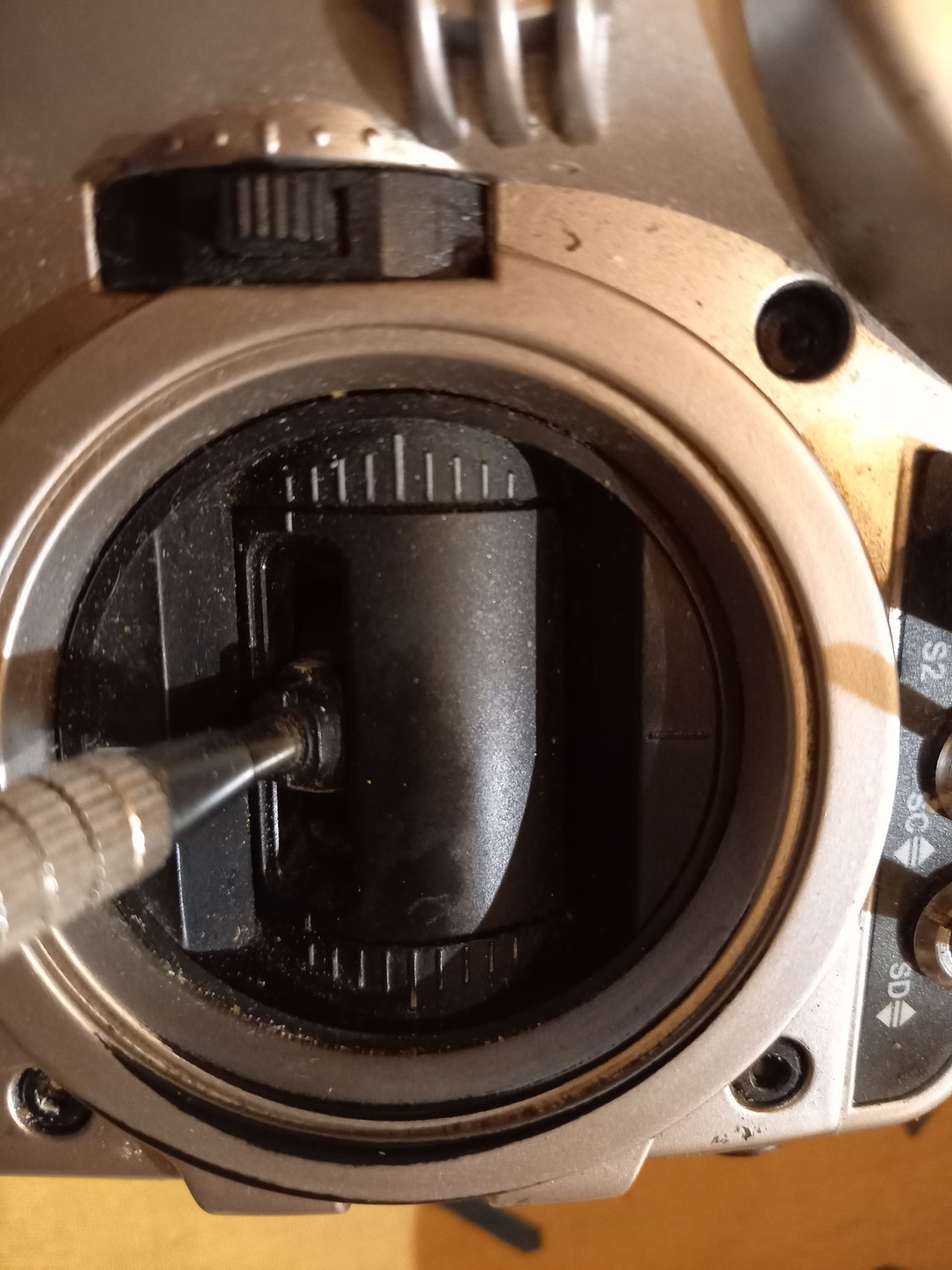
Sorry for the pic being sideways, I am not smart enough with computers to rotate it.
3: Correct. FIRST run, the solenoid is open 100% all the way, and that run is to determine what the main needle position needs to be. Once you have reached full throttle according to the procedure described earlier, tune for max RPM, then slightly open the needle to the first click where you can audibly hear RPM drop again. Some people have trouble hearing this. If you have a tacho, tune for roughly 500~1000 RPM rich from peak.
4: Yes... In rare cases, if RPM of midstick is too high or too low, I might slightly alter the throttle curve later which of course also requires a retuning of the fuel curve, but any curve resembling this one will usually be close enough, and as I allready said, it does not have to be superduper precise.
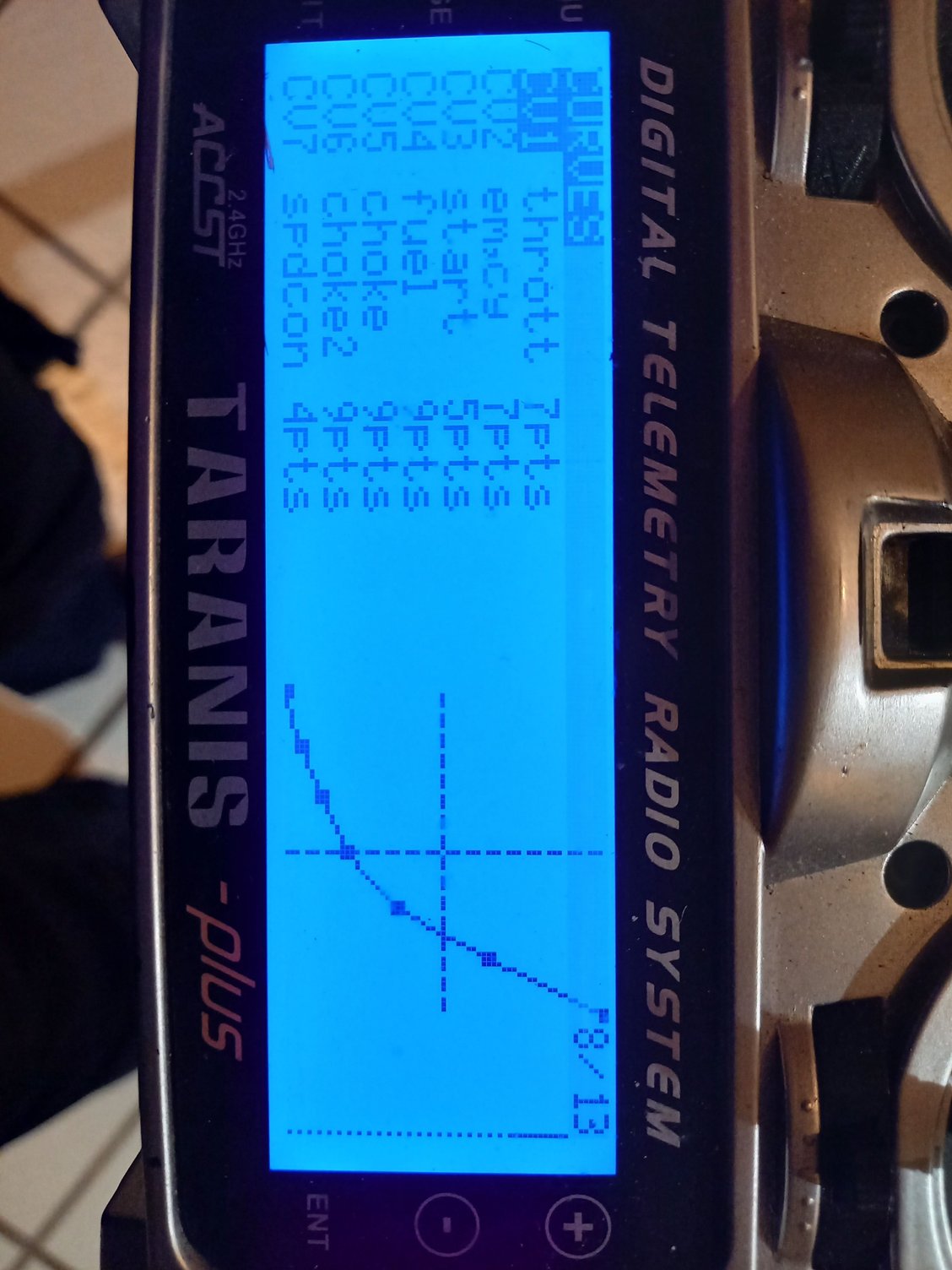
Same story, rotated, apologies.
5: I have experimented with 5, 7, 9 and even with 17 points. For purposes of accuracy, 5 points is enough but noticably "imprecise", 7 points is usable, 9 points marginally better than 7, and anything above 9 only is confusing, but does not lead to better results.
Initially I used 7 points (as can be seen from the throttle curve, which I did not change) but I found that in order to set the fuel curve you need to be able to consistently find the same throttle position again and again.
That is when I started using the index next to the stick, and since my transmitter has 9 index points, 9 curve points it is...some transmitters have 7 indexpoints, others have no index at all, and then you need to use other means availlable. Some transmitters allow to show the stick position in a display screen. I cannot tell from here, what the oiptions for your particular gear are.
In any case, some engines have really weird fuel curves.
This is one example of a weird curve:
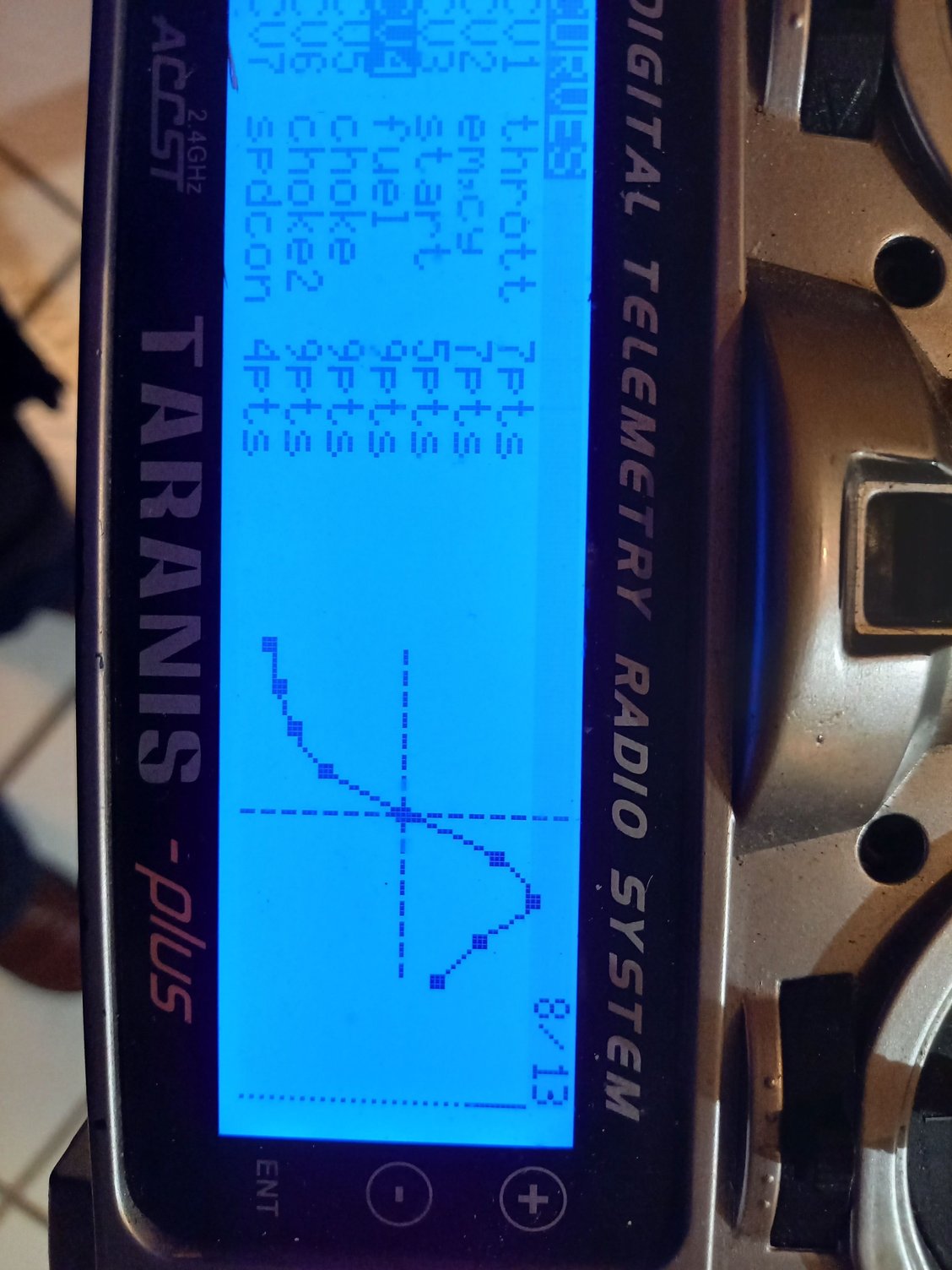
But more common, they look a bit like this:
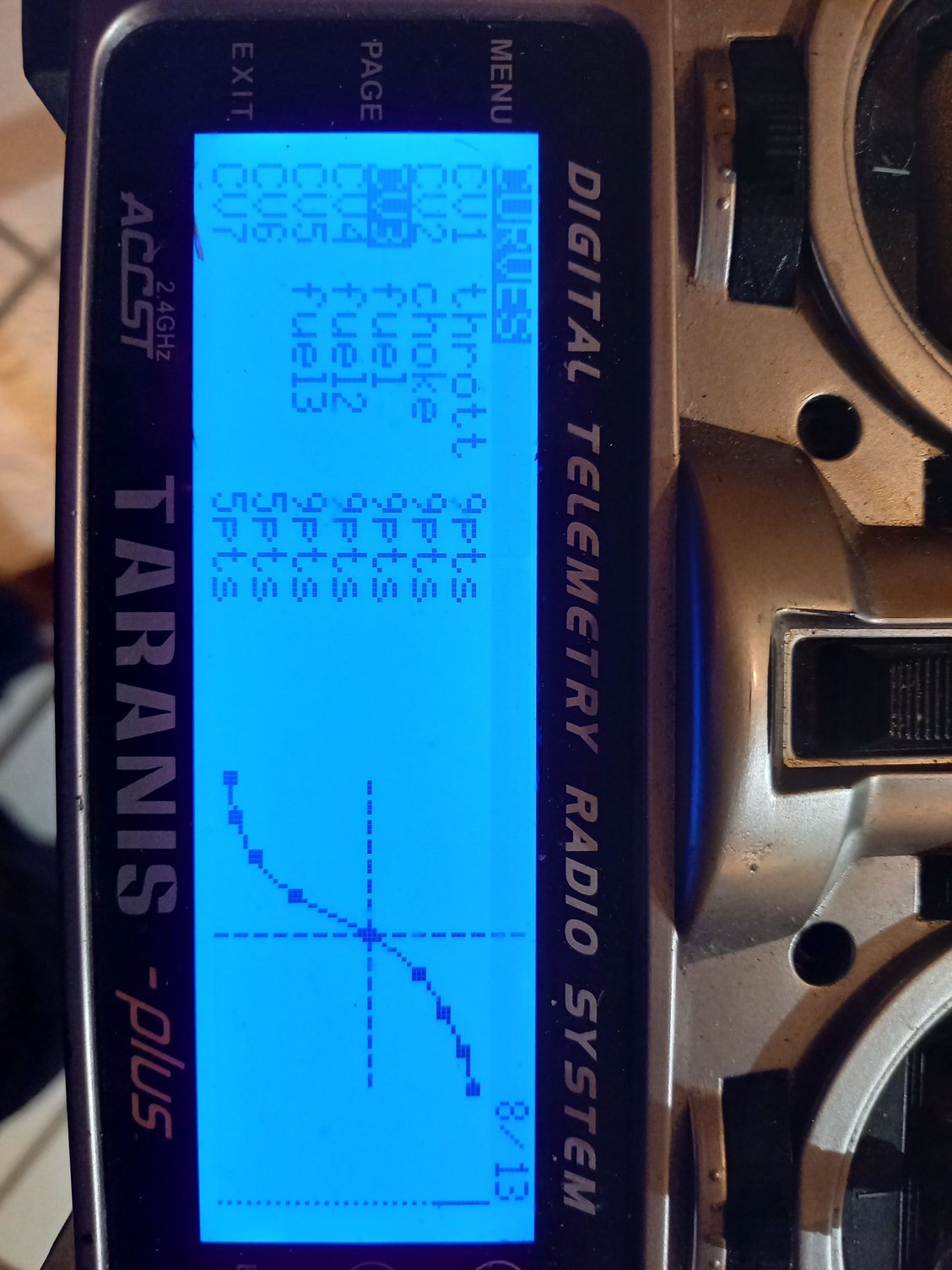
or this:
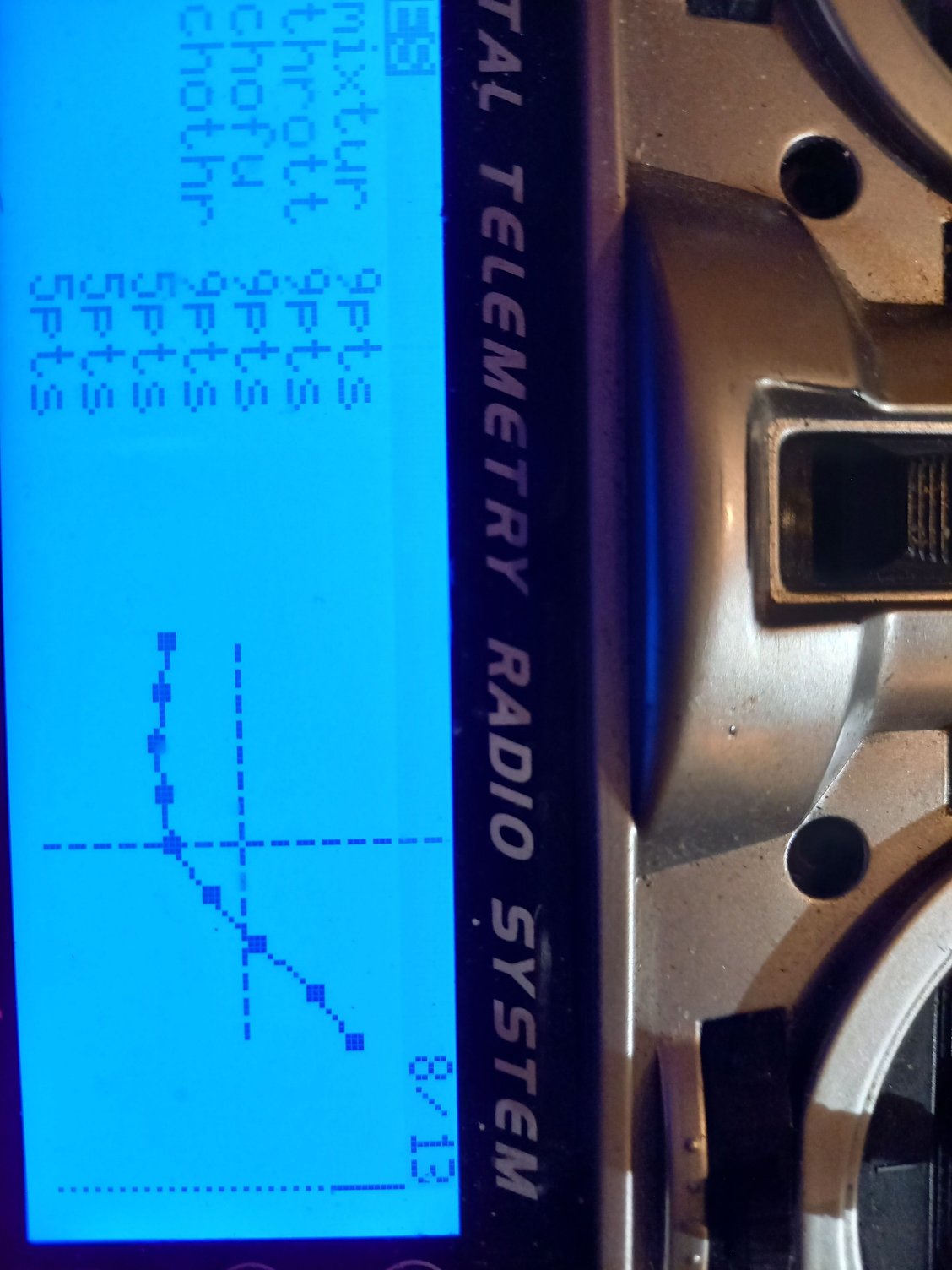
The shape of the fuel curve CAN be influenced by the position of the low speed needle. Closing it a touch, forces you to raise the low end of the curve a bit, opening it up, forces you to lower the low end a bit.
A too low curve looses resolution, it is always advisable, especially when you have trouble getting mixture correct in the low range, to force the curve up a bit by ever so slightly closing the LS needle.
6: No worries... I invented this system, and I asked myself these same questions over and over, and it took us just as much time to grasp the idea of how this thing actually works.
7: you're welcome!
PS: I happen to be home right now (not where I wanted to be, more specific HOW I wanted to be, got myself the mother of all hernias, darnit) so I will get your solenoid housings in the mail on monday.
09-21-2025 | 11:12 AM
#109
Hi Bert, thanks very much, looking forward to my delivery. Hope you get your hernia sorted, can't be nice.
The throttle doesn't have any markings and the ratchet has 22 indents, so that's going to be fun, funnily enough the airelons have 7 markings, but I don't know if the rachet corresponds (no point looking). I'll have to make an inlay which will hopefully line up with the rachet. I suppose if the system is sensitive one notch may make a difference? Always something. As a matter of interest what do the corresponding curves look like for the valve?
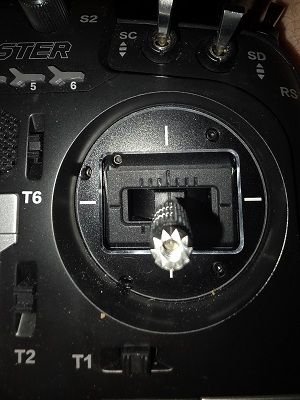
That is when I started using the index next to the stick
09-21-2025 | 08:49 PM
#110
Hi Bert, thanks very much, looking forward to my delivery. Hope you get your hernia sorted, can't be nice.
The throttle doesn't have any markings and the ratchet has 22 indents, so that's going to be fun, funnily enough the airelons have 7 markings, but I don't know if the rachet corresponds (no point looking). I'll have to make an inlay which will hopefully line up with the rachet. I suppose if the system is sensitive one notch may make a difference? Always something. As a matter of interest what do the corresponding curves look like for the valve?
The throttle doesn't have any markings and the ratchet has 22 indents, so that's going to be fun, funnily enough the airelons have 7 markings, but I don't know if the rachet corresponds (no point looking). I'll have to make an inlay which will hopefully line up with the rachet. I suppose if the system is sensitive one notch may make a difference? Always something. As a matter of interest what do the corresponding curves look like for the valve?
As for the bolded: A bit confused, because I posted 3 examples of possible fuel curves (from 3 different engines)? Of the four curves I posted, the first one is a generic throttle curve. They all look like that, they all are a progressively increasing curve, individual differences are at best the value at midstick being slightly higher or lower, but they all start at -100, and end at +100 in a single progressive curve upwards.
The other three are fuel curves. They can look like anything, but common properties are that they are "smooth" (no strange spikes) and they usually have a vague S-shape like the 3rd pic from top, or a U shape like the last pic.
The first fuel curve (2nd pic from top) is a bit of an outlier with its sharp drop at the top of the throttle range, and I have no explanation as to why it is shaped like that, It is the only one of my engines that requires a cyrve like that...
09-25-2025 | 06:12 AM
#111
Why not simply have your radio play the value of the throttle stick? Special function, play value, throttle, every 5 seconds. Assign it to a switch so you can turn the function off when not needed.
It will play the value -100 to 100 and you will have the exact value.
It will play the value -100 to 100 and you will have the exact value.
 09-25-2025 | 10:19 PM
#113
 I think that is what I said?
You can try making a temporary (or more permenent) index yourself, or you can perhaps do your testruns with the stickpositions "on screen"? Another option is to use the call-function, where activating the momentary switch (the one that springs back when you let go of it) to audibly call out the stick position.
Last edited by 1967brutus; 09-25-2025 at 10:22 PM.
09-25-2025 | 10:29 PM
#114
I made that mistake once or twice...
09-25-2025 | 11:54 PM
#115


